

Festo’s Strategic Blueprint: Navigating the Future of Industrial Automation Through Genuine Innovation and Ecosystem Collaboration
Session: Success Factor of Innovation Ecosystem: Best Practices from Festo
Speaker: Frank Notz (CSO, Festo SE & Co. KG)
Summary:
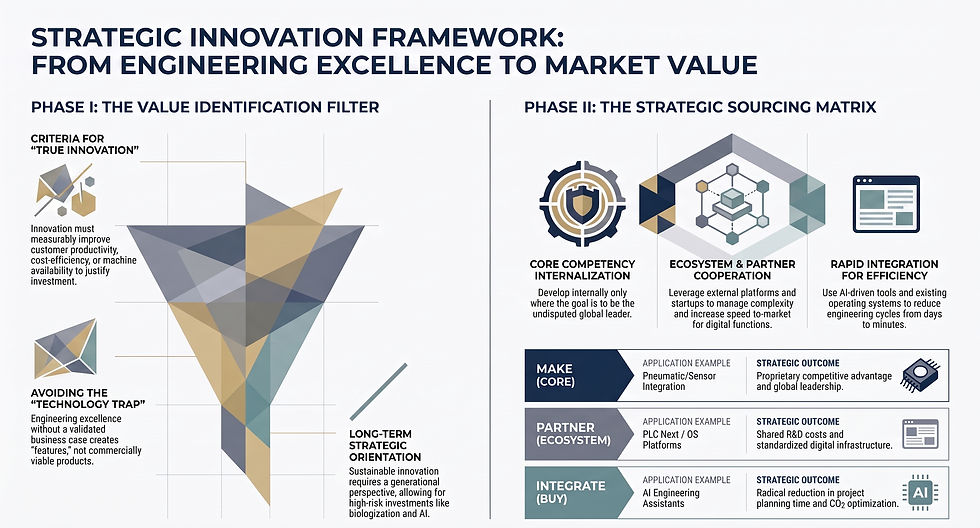
True innovation must solve concrete customer challenges—boosting productivity, cost efficiency, or machine availability—to build a viable business case rather than just a technical feature.
Festo retains its core competencies in-house while actively co-innovating within ecosystems, partnering with startups like Z Alpha for AI-driven engineering and established giants like Phoenix Contact for PLCnext Technology.
Backed by risk-tolerant, long-term family ownership, Festo invests in futuristic mega-trends like Biologization while maintaining a pragmatic focus on simplifying everyday, traditional automation solutions.
As industrial automation advances at a rapid pace, the question of what constitutes true innovation becomes paramount for legacy organizations. For Festo SE & Co. KG, a global leader in automation technology that recently celebrated its 100-year anniversary, planning for the next century requires a pragmatic grounding in market realities rather than abstract future concepts. Frank Notz, Chief Sales Officer (CSO) of Festo SE & Co. KG, outlines a comprehensive strategic blueprint that combines rigorous internal development, collaborative ecosystems, and targeted technology acquisitions.
Redefining Genuine Innovation
A central pillar of Festo's philosophy is establishing what truly qualifies as an innovation. According to Notz, a genuine innovation must definitively solve an actual problem or generate an entirely new demand. In the industrial automation sector, these challenges are highly specific and operational:
Increasing customer productivity
Driving cost efficiency
Improving the long-term availability of machines
If a new product fails to address these concrete issues, customers will not pay for it, rendering the development a mere "feature" rather than a true innovation. This distinction is vital in traditional engineering cultures where developers can easily become overly infatuated with technology. Notz emphasizes that engineers must continuously challenge themselves to ensure their technological advancements are anchored to solvable, real-world problems, especially as future industrial solutions increasingly combine physical hardware with software and artificial intelligence.
To identify these future challenges systematically, Festo utilizes tools like a Trend Radar. While customers may not be able to articulate the exact product they will need tomorrow, they are exceptionally adept at describing their future operational bottlenecks—such as the inevitable need to automate tasks that are currently performed manually.
The Ecosystem Approach: Build, Partner, or Buy
As technological fields become increasingly complex, particularly with the convergence of digital systems and traditional hardware, Festo recognizes that no single company can master everything in-house. Consequently, under Notz's strategic direction, the company employs a three-pronged strategic framework for modern research and development:
In-House Core Competencies: Companies must identify where they truly differentiate themselves and secure sustainable competitive advantages. For these core competencies, the goal must be to remain the best in the world, keeping development strictly in-house.
Embracing Partnerships: For broader, complex topics—especially digital initiatives—companies must abandon the outdated mindset of doing everything internally just to maintain complete control. Instead, they must cultivate the courage to open up and engage in collaborative ecosystems.
Focus on Integration: It is highly inefficient to waste development resources on building components that are already available on the open market. Purchasing and seamlessly integrating finished technologies drastically increases a company's speed to market.
Three Pillars of Festo’s Practical Innovation Strategy
To illustrate this ecosystem strategy in action, Festo implements three distinct pathways depending on the technology and market need:
Integrating AI via Startup Collaboration (Z Alpha): Engineering a new machine traditionally required days of manual work reviewing extensive catalog data sheets. To revolutionize this, Festo partnered with the startup Z Alpha to integrate a Large Language Model (LLM) and artificial intelligence into their workflow. This tool reduces project engineering work from days to mere minutes, instantly calculating complex metrics like CO₂ footprints and energy consumption for specific automation tasks. Notz emphasizes that this AI is strictly purpose-built for engineering; it will not answer general inquiries, such as identifying Festo's Sales Board Member.
Cooperating with Established Industry Players (Phoenix Contact): Festo partnered with Phoenix Contact on "PLCnext Technology," an operating system for automation that functions similarly to Microsoft Windows for industrial computers. Developing this internally would have cost Festo hundreds of person-years in investment and severely delayed their time-to-market. Commercially, this is not a joint venture, nor does it rely on a revenue kickback model; rather, both companies share a common goal of expanding the platform, with Festo paying directly for the foundational IT functionality they co-develop.
Strategic Technology Acquisition (Bond Manifold): Festo acquired a specialized technology known as Bond Manifold. This award-nominated technology enables the integration of valve and sensor functions to create highly customized solutions for personalized medicine and cancer patient treatments. This demonstrates how targeted acquisitions can effectively expand a company's capabilities into new, high-growth sectors.
Learning from Failure and Looking to the Future
Innovation is not without its missteps. Notz candidly shares the story of a pneumatic collaborative robot (cobot) that Festo once prominently showcased at the Hannover Messe. While the technology was sensational—offering a highly yielding and safe robot capable of working alongside humans due to Festo's pneumatic expertise—it ultimately failed commercially. The market standard had already shifted to electric cobots, leaving Festo without a viable business case. This served as a potent lesson in the dangers of falling in love with a technology without confirming actual market demand.
Despite such setbacks, Festo’s structure as a family-owned business affords it exceptional long-term orientation and high risk tolerance. This structure allows the company to invest in futuristic mega-trends that may not yield immediate returns, such as "Biologization"—the strategic, long-term replacement of chemical processes with biological ones, which Festo believes will become a massive trend.
To fuel this continuous innovation pipeline, Festo actively engages with innovation hubs like UnternehmerTUM in Munich, utilizing pitch events to source startup partners. When selecting partners, Festo prioritizes the startup's ability to solve a specific technological need, followed closely by cultural chemistry—acknowledging the inherent challenges of blending a large corporate structure with an agile startup mentality.
Looking ahead, Notz’s agenda prioritizes the deep integration of AI and software, alongside traditional automation solutions designed to make customers' daily operations significantly easier today. By maintaining a balanced focus on immediate problem-solving and long-term future trends, Festo continues to define the next generation of industrial automation.


