

The Fusion of 100-Year Infrastructure Expertise and Cutting-Edge AI: Inside Hitachi’s "H max" and the Frontier of Physical AI
- Miki Sadinov
- Jul 8
- 4 min read
In the world of mission-critical infrastructure—power grids, high-speed railways, hospitals, and water systems—there is zero room for error. The Silicon Valley mantra of "fail fast, fail often" cannot be applied to systems that sustain human lives and modern society. It is within this demanding environment that Hitachi is deploying "Physical AI"—a paradigm that marries physical operational technology (OT) with advanced artificial intelligence.
This article explores the global insights shared by Hitachi's energy and mobility specialists, detailing how their new software suite, H max, is transforming key industrial sectors.
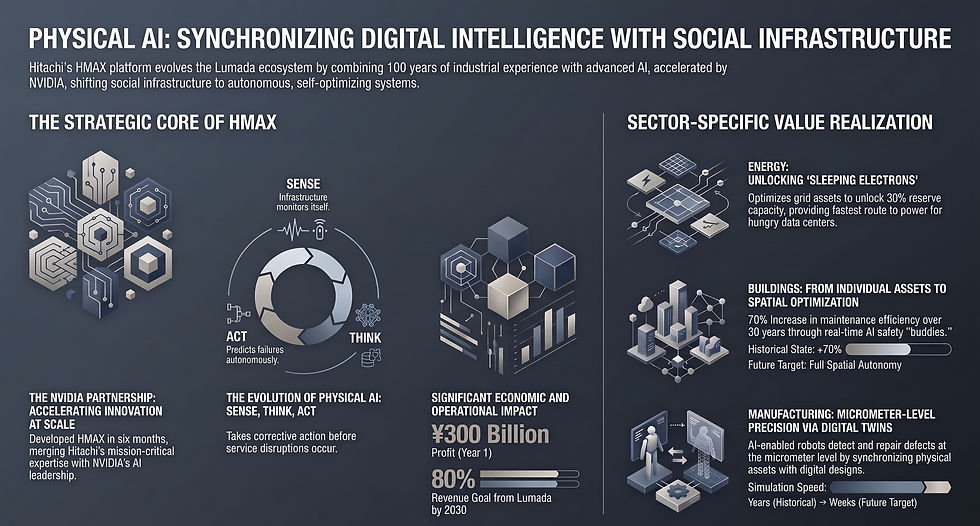
1. The Symbiotic Cycle of H max Energy: Unlocking "Sleeping Electrons"
As artificial intelligence scales globally, it presents a profound paradox: AI requires an immense amount of energy, yet the energy grid desperately needs AI to manage its rapidly increasing complexity. According to Ulf Miller, the leader of Hitachi's energy segment, the global power system is undergoing an unprecedented transformation characterized by massive demand spikes and highly erratic load behaviors from data centers.
The Grid Crisis and the H max Energy Solution
Rapid Electrification: Global electricity demand is projected to grow by 70% within the next decade. Because physical infrastructure cannot be built fast enough to keep pace, the industry must find ways to optimize existing assets.
The Problem with Renewables: While renewables account for 90% of new power generation capacity globally, their inherent intermittency poses severe stability risks to transmission grids.
From Passive to Intelligent Assets: Historically, grid assets like transformers and switchgear operated on static setpoints. H max Energy infuses intelligence into these devices, utilizing High-Voltage Direct Current (HVDC) and advanced power electronics to actively compensate for real-time grid fluctuations.
NVIDIA Partnership for Ultra-Fast Simulation: Planning new interconnections or data center integrations used to require years of simulation studies. Through Hitachi's partnership with NVIDIA, these complex grid simulations and planning studies are significantly accelerated, reducing times that historically took years to streamline the design and manufacturing of products.
Reclaiming the "Sleeping Electrons"
The fastest way to increase power capacity is not to build new plants, but to unlock the "sleeping electrons"—the reserve capacity currently dormant within existing energy networks. In the United States, this reserve capacity is estimated to be around 30%. By using H max Energy to dynamically monitor and control grid assets, operators can safely tap into these reserves, channeling them directly to power-hungry data centers.
2. Smart Factories: Giving a "Brain" to Manufacturing and Mobility
In the industrial sector, traditional automation is no longer sufficient. Gianfranco Messina, a specialist in mobility and smart factories at Hitachi, emphasizes that geopolitical tensions, climate change, cyber risks, and an aging workforce demand a shift from simple efficiency to intelligent, adaptive manufacturing.
Hitachi's answer is to give the factory a brain by creating a continuous loop between the digital design space and the physical shop floor.
The Physical-Digital Loop Process:
Sensory Detection: High-precision sensors on physical assets (such as massive railway carriage panels) identify microscopic defects down to the micrometer level.
Digital Twin Translation: Upon defect detection, the system automatically generates a dynamic physical-digital twin.
Gap Analysis: The AI compares this twin with the original CAD design data and instantly calculates the gap.
Autonomous Action: The AI directly transmits repair instructions to the robot, which immediately performs a "clean and cut" repair on the spot.
Case Study: The Hagerstown Digital Factory
At Hitachi’s state-of-the-art digital facility in Hagerstown (Agerstown), USA, AI is embedded across the entire value chain to handle unpredictable physical variables:
Micro-meter Defect Detection: On large manufacturing lines, such as those producing massive metal panels for high-speed trains, robots equipped with advanced sensors can identify microscopic weld defects.
Autonomous Self-Healing: Once a defect is detected, the system automatically generates a physical-digital twin. It compares it with the original CAD design, calculates the gap, and instantly instructs the robot to clean, cut, and repair the defect on the spot.
Regulatory Compliance & "Human in the Loop": In alignment with strict safety standards and frameworks like the European AI Act, Hitachi ensures that critical decision-making processes always maintain human oversight, combining machine speed with human judgment.
3. Shifting from Point to Space Optimization in Buildings
Takeshi Yamamoto, who leads Hitachi's building systems business, highlights that over the past 30 years, remote diagnostics and digital maintenance have achieved approx. 70% work efficiency gains. Today, however, the focus is shifting from "point optimization" to "entire spatial optimization".
The AI Buddy in Maintenance Safety
To address labor shortages and ensure safety, Hitachi uses wearable cameras and data to enhance the capabilities of field engineers:
Harness Hook Alert: If an engineer fails to attach safety gear correctly, the AI buddy alerts: "Harness hook is not attached correctly. Confirm hook attachment and show it to the camera."
Escalator Step Removal Alert: If a worker approaches an escalator with missing steps, the AI warns: "Escalator step is removed. Confirm power isolation and pay attention to falling/tripping. Running in this state could lead to a major accident."
Automated Reporting: Post-inspection, the system automatically generates reports based on the collected physical data, integrating field judgment and AI support.
4. The Vision: A "Harmonized Society"
The ultimate goal of Physical AI is not just the optimization of individual factories or grids, but the realization of a Harmonized Society.
As Hitachi's Silicon Valley-based digital business leader Taniguchi (Tani-san)—who transitioned from a software engineer in healthcare to an operational technology specialist—explains, different industrial layers are deeply interdependent. Running high-speed, automated rail networks requires vast amounts of electricity, and the data centers executing Physical AI computations demand massive grid support.
By establishing a digital thread that links Energy, Mobility, and Industry, Hitachi is building a cooperative ecosystem where infrastructure assets communicate, share resources, and self-optimize in real time. Backed by over a century of operational expertise, Hitachi is uniquely positioned to lead this next industrial era.


