

Realizing Industrial AI at Scale: How AWS, Volkswagen, and NEURA Robotics are Transforming Manufacturing
Session:
Realizing Industrial AI at Scale with AWS
Speakers:
Ozgur Tohumcu (AWS Representative)
David Reger (Founder and CEO of NEURA Robotics)
Florian Lechner (Head of Digital Production and Logistics at Volkswagen AG)
Session Summary: This session explores how organizations can successfully deploy and globally scale industrial and physical AI to transform their manufacturing operations. Featuring practical use cases from NEURA Robotics and Volkswagen Group, the presentation highlights the impact of digital twins, cognitive robotics, and unified cloud ecosystems like the Digital Production Platform. The overarching message emphasizes that realizing true transformational value requires establishing operational trust and designing systems for global scale from day one.

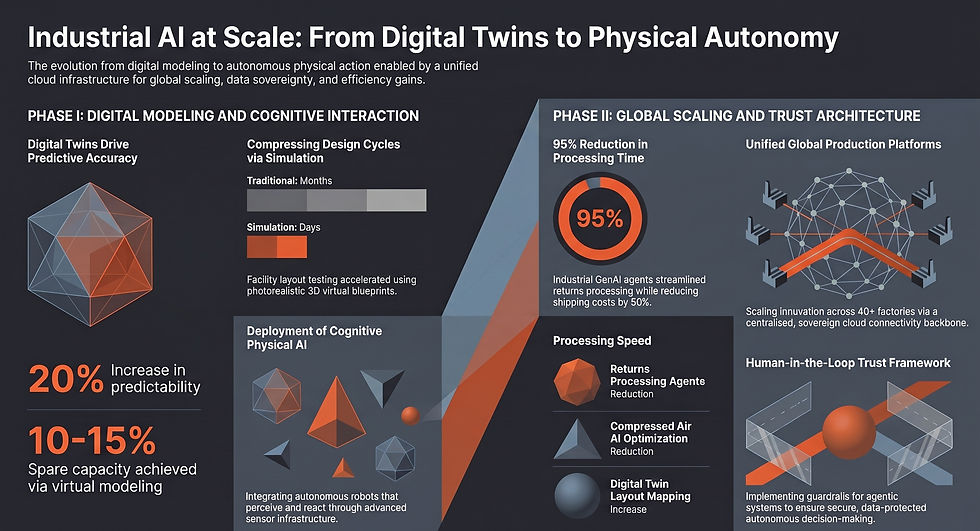
The landscape of industrial manufacturing is undergoing a profound transformation, shifting from localized automation to globally scaled, AI-driven ecosystems. At a recent AWS presentation, industry leaders discussed the critical milestones required to successfully deploy physical and industrial AI. Through advancements in digital twin technology, cognitive robotics, and secure cloud infrastructures, companies are actively remodeling how machines interact with the physical world.
The Power of Digital Twins: PepsiCo’s Physical AI Transformation
A foundational step in deploying industrial AI is the ability to create highly accurate digital replicas of physical environments. This enables organizations to test and model operational changes virtually, minimizing the risk of disrupting existing factory workflows.
PepsiCo serves as a prime example of this digital transformation. The company successfully mapped a digital blueprint of its global operations, creating 3D, photorealistic images of every machine, conveyor belt, pallet, and operator path. To achieve this, PepsiCo utilized Siemens' digital twin composer, accelerated by Nvidia Omniverse, and powered by Nvidia GPUs running on AWS.
The business outcomes of this virtual testing environment were significant:
Accelerated Design Cycles: Facility layout testing that previously took months or years was compressed into mere days.
Increased Efficiency: The company achieved an approximate 20% increase in predictability.
Optimized Infrastructure: Spare capacity availability increased by 10% to 15%, as the digital twin revealed that conveyor belts were not necessary for pallets across all operations.
Addressing Labor Shortages with Cognitive Robotics
As the global workforce ages and skilled humans retire faster than new workers can be trained, robotics and physical AI present a massive opportunity. David Reger, Founder and CEO of NEURA Robotics, highlighted how his company is addressing this gap by building cognitive robots capable of hearing, seeing, feeling, thinking, and reacting fully autonomously.
Rather than solely focusing on individual machines, NEURA Robotics is building a worldwide infrastructure to distribute trained skills across global robot fleets. The company has developed a marketplace platform called the "neuroverse," which enables users to train a "personal adjusted brain" with proprietary know-how and then optionally distribute that knowledge globally.
To accelerate this vision, NEURA Robotics announced a strategic partnership with AWS. Key highlights of this collaboration include:
Infrastructure Integration: NEURA Robotics leverages Amazon's existing infrastructure, which already supports a fleet of a million robots.
Accessible Training: By integrating Alexa and utilizing Amazon SageMaker, the partnership allows users to train robots without needing to be professional AI developers.
Interconnected Devices: The technology allows robots to connect directly to the AI models and sensors of other smart devices, such as the "eyes" of a smart fridge, to streamline operations.
Establishing Trust and the European Sovereign Cloud
While the technology for physical AI exists, scaling it into legacy "brownfield" environments requires immense trust. Deploying AI must not disrupt existing supply chains, Manufacturing Execution Systems (MES), or Product Lifecycle Management (PLM) systems.
This need for trust is particularly crucial as the industry shifts toward "agentic systems"—AI that goes beyond making recommendations to actively implementing operational changes. To support hypersensitive workloads and protect intellectual property, AWS launched the European Sovereign Cloud. Representing a €7.8 billion investment initiated 18 to 24 months ago, this independent infrastructure operates entirely within the EU, managed exclusively by EU staff using completely sovereign technology.
With secure foundations in place, AWS implements strict guardrails and human-in-the-loop protocols to monitor agentic systems. For example, through a collaboration with Infor, an AI agent called "express bots" was deployed specifically to manage returns processing. This implementation resulted in a massive 95% reduction in processing time and a 50% reduction in expiry shipping costs.
Volkswagen Group: AI on a Global Scale
Volkswagen Group (VW) provided a powerful case study on scaling industrial AI across a massive production network. Florian Lechner, Head of Digital Production and Logistics at Volkswagen AG, detailed the company's Digital Production Platform (DPP), built in partnership with AWS since 2019.
The DPP unifies VW's global footprint into a single cloud ecosystem, focusing on "edge-to-edge innovation" starting right at the factory floor. The platform is currently live with over 66 expanding use cases across more than 40 factories worldwide.
Notable AI implementations at Volkswagen include:
Maintenance Chatbot (Genius AI Platform): VW built a generative AI platform called Genius on top of the DPP. The company centralized global operating manuals and siloed maintenance knowledge into this system. It seamlessly shares best practices across international plants (such as between Germany and Spain), overcoming language barriers and reducing operator reaction times during machine downtimes down to mere seconds.
Compressed Air Agent: Compressed air used in welding and painting is a highly expensive energy driver via kilometer-long pipelines. VW deployed an AI agent to collect compressor data, predict usage, and regulate the systems. Utilizing a human-in-the-loop approach before transitioning to automated decision-making, this agent achieved a 10% reduction in power consumption, directly supporting VW's goal of zero CO2 emissions by 2050.
Supply Chain Optimization: AI is actively used to generate perfect production sequences, ensuring highly flexible and efficient manufacturing processes.
Conclusion: Moving from "Spaghetti" to "Lasagna" Systems
The success of these highly structured, cloud-based AI deployments is beginning to influence a wide variety of industrial sectors. For instance, a mining company recently observed Volkswagen's architecture and noted that the transition was akin to moving from tangled, chaotic "spaghetti systems" to highly organized, layered "lasagna systems".
Ultimately, as manufacturers look to bring physical AI onto the shop floor, the defining takeaway from industry leaders is that piecemeal, localized deployments are no longer sufficient. In order to realize the true transformational value of artificial intelligence, organizations must prioritize robust digital foundations and design for global scaling from day one.


