

Bridging the Chasm: Do Startups Really Grow by Partnering with Corporate Giants?
- Miki Sadinov
- Jul 19
- 4 min read
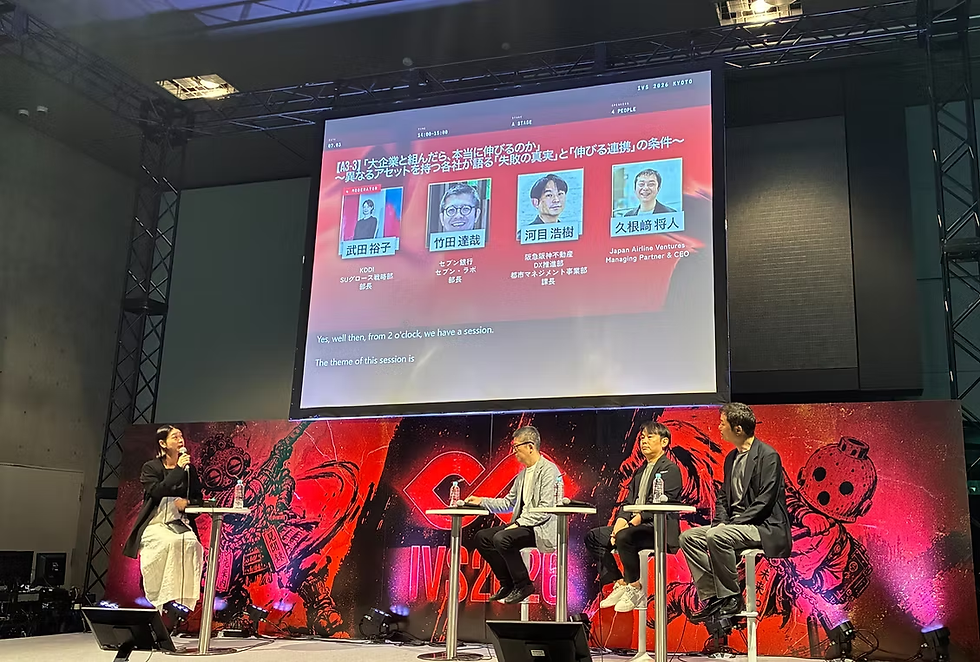
In the traditional narrative of Japanese industry, the "chasm" between agile startups and massive conglomerates was once viewed as a cultural divide bridged primarily by financial transactions. However, as Japan faces accelerating demographic shifts and global competitive pressures, this chasm has evolved into the most significant hurdle—and opportunity—for national innovation. At the IVS2026 panel, Ms. Yuko Takeda of KDDI framed the stakes with clinical precision: Does partnering with an incumbent actually drive growth, or is it a structural trap that stifles agility? For Japanese giants, "Open Innovation" has moved beyond its origins as a corporate social responsibility buzzword to become a strategic necessity for survival. Yet, the paradox remains: while startups possess the speed incumbents lack, the structural gravity of a multi-billion-yen corporation can crush a nascent partner before a pilot program even concludes. To understand whether these partnerships truly scale, we must look past the capital and into the operational machinery of the giants themselves.
The Arsenal: Deconstructing High-Value Corporate Assets
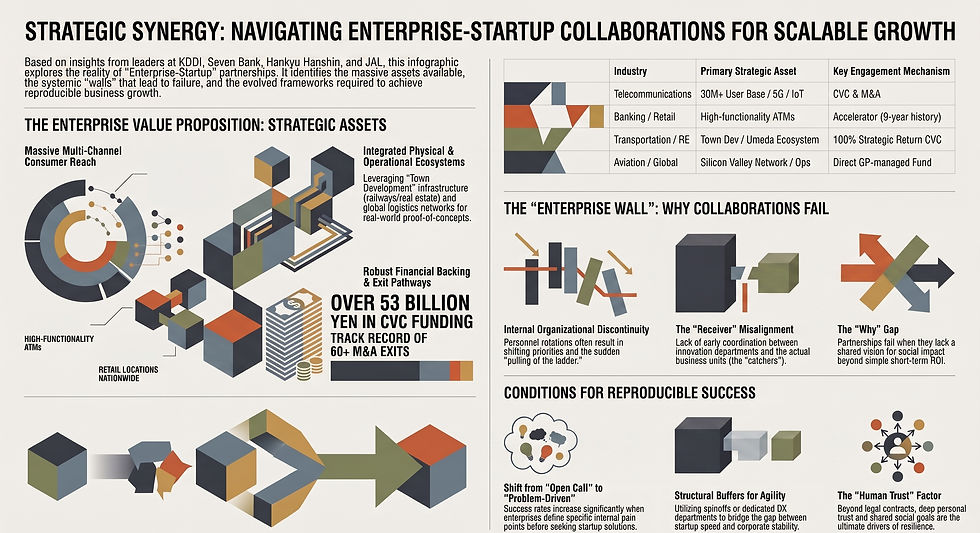
True value for a startup is rarely found in the investment check alone; it lies in "operational infrastructure"—pre-built systems of trust, logistics, and customer access that a startup would take decades to replicate. When deployed correctly, these assets serve as the ultimate propellant for accelerated scalability. The panel highlighted four distinct "arsenals" currently available to the Japanese ecosystem:
KDDI Corporation (Ms. Yuko Takeda): Beyond its JPY 53 billion CVC scale, KDDI offers a massive "surface area" for testing, including a 30-million-strong customer base across its au, UQ mobile, and povo brands. Its footprint extends to 14,000 Lawson stores, while its "Mugen Labo" program acts as a gateway to over 100 other major corporations.
Seven Bank (Mr. Tatsuya Takeda): Operating as a "maker-centric" bank led by an engineer CEO, Seven Bank manages a network of 28,538 ATMs. Through a strategic alliance with Itochu and FamilyMart, this network is expanding to 44,000 locations, with 4,000 units to be added over a three-year horizon. These are high-performance digital nodes capable of NFT distribution and ID verification. The synergy between Seven Bank and the gig-work platform Tynee illustrates a transition from simple cash-dispensing to providing "Social Utility," leveraging real-time 24/7 payouts to redefine the liquidity of labor.
Hankyu Hanshin Properties (Mr. Hiroki Kawame): Managing the "surface" of Osaka’s high-traffic Umeda district, this firm provides a physical urban fabric for deployment. Its JPY 1 billion fund focuses on 100% strategic returns, and while the fund is modest, the firm’s commitment is evidenced by its collaboration with nearly 150 co-creation partners.
Japan Airlines Ventures (Mr. Masato Kunezaki): With five of its six members based in Silicon Valley, JAL offers a global bridgehead. Beyond aircraft maintenance and mileage programs, JAL provides instant brand credibility—a vital asset for startups seeking international legitimacy.
While these assets are formidable, their deployment often founders upon the realities of corporate inertia and strategic entropy.
The Coordination Vacuum: Why Partnerships Fail
The landscape of Japanese innovation is littered with the "POC (Proof of Concept) trap." Failure in these partnerships is rarely a result of technological deficiency; it is a casualty of the "coordination vacuum"—the space where startup speed meets corporate friction. A post-mortem of panel-shared failures reveals three recurring structural traps:
The first is the Model Mismatch, illustrated by a JAL logistics case. The startup attempted to bring an overseas efficiency model to Japan, only to find that the fundamental operational metrics—specifically the "empty-car rates" of Japanese trucks—rendered the startup’s algorithms irrelevant. The second is the Isolated Pilot, as seen in Hankyu Hanshin’s 2019 navigation trial. Despite elite technology, the absence of a "divisional catcher"—a specific business unit lead—meant the trial remained a guerrilla project. Without a path to institutional adoption, the partnership withered. Finally, there is the "April Wall" described by KDDI. This occurs when a successful pilot, having already secured a budget for full-scale rollout, is abruptly halted because the department manager—the project’s internal champion—is rotated to a different division. The tragedy of the April Wall is not merely a missed meeting; it is the systemic loss of institutional memory and a secured budget.
Institutional Readiness: Engineering Reproducible Success
To move beyond accidental success, incumbents are now "engineering" their internal structures to match startup speed. This "Institutional Readiness" represents a shift from doing isolated pilots to building integrated platforms for growth.
Recognizing that traditional corporate decision-making is too slow, JAL shifted its second fund to a Direct Management GP model. This allows the investment team to bypass the "slow decision-making" of a 100% corporate subsidiary and move at market speed. Similarly, Hankyu Hanshin Properties solved the "catcher" problem by appointing 40 representatives across various business divisions to serve in dual-role concurrent posts. These individuals serve as permanent "landing windows" for startups, ensuring that a pilot has an immediate internal home.
KDDI is exploring a Spinoff Model, where internal business units are carved out into agile subsidiaries that can adopt startup-friendly HR and incentive structures. The gold standard for this lifecycle management remains the "Swing-By IPO" of Soracom. By acquiring the startup, accelerating it within the corporate ecosystem, and then allowing it to re-list as a public company, KDDI proved that a giant can be a launchpad rather than a terminal destination. Yet, as JAL’s Mr. Kunezaki noted through his "Kyoto Morning Run" anecdote, deep personal trust remains a vital complement to these legal structures. A shared run to Kiyomizu-dera forged a level of alignment that no contract could replicate.
The "Give First" Philosophy and the Path Forward
The future of Japanese innovation is not a zero-sum game between the legacy giant and the disruptive newcomer. Instead, it is moving toward a symbiotic ecosystem where the corporation provides the stable foundation and the startup provides the directional speed.
This transformation requires a philosophical shift. Seven Bank’s "Give First" founding principle serves as the cultural prerequisite for structural change: incumbents must offer assets and insights without demanding immediate, myopic ROI. Conversely, startups must navigate corporate ego by proposing "adjacent angles"—tangential solutions that solve a corporate pain point without directly challenging the domain expertise of internal teams.
Ultimately, the most successful partnerships are those that look beyond the balance sheet to ask: How will this change society? When a giant’s reach is combined with a startup’s vision to solve social problems—be it financial inclusion or urban mobility—growth is no longer a question of "if," but "how fast." The path forward requires incumbents to be ready to "catch" what the startups throw, and for startups to recognize that the giant’s assets are the most powerful lever they will ever pull.


