

Government as a Catalyst: Building Next-Generation Industries Through Public Demand
- Miki Sadinov
- Jul 19
- 4 min read
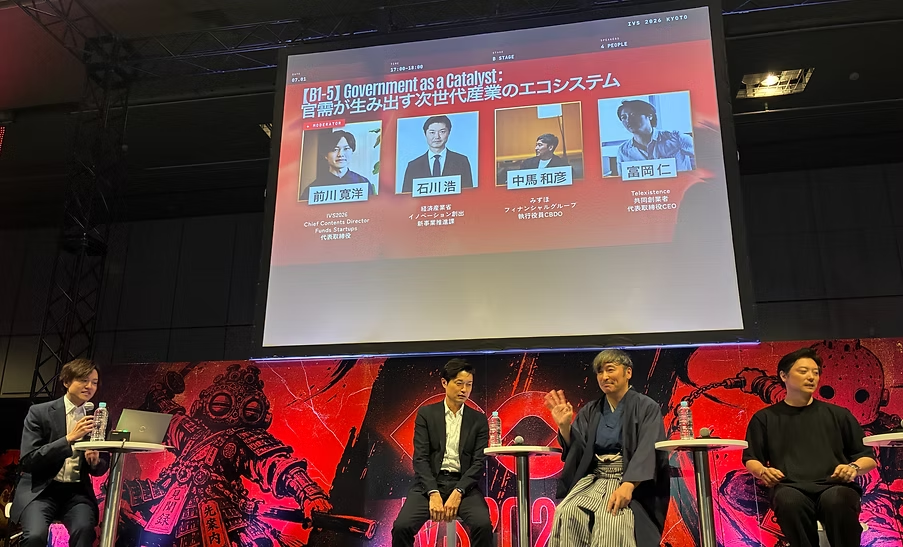
At the IVS2026 session "Government as a Catalyst: Building Next-Generation Industries Through Public Demand"—held under the event’s banner theme of "Japan’s Back"—industry leaders and policymakers gathered to outline a radical paradigm shift in Japan’s industrial and startup strategy.
The panel brought together a prominent lineup of speakers:
Hiroshi Ishikawa, Director, Innovation and New Business Promotion Division, Ministry of Economy, Trade and Industry (METI)
Kazuhiko Chuma, Executive Officer and CBDO, Mizuho Financial Group / Mizuho Bank
Jin Tomioka, Representative Director and CEO, Telexistence
Hiro Maekawa, Representative Director of Funds Startups (moderator)
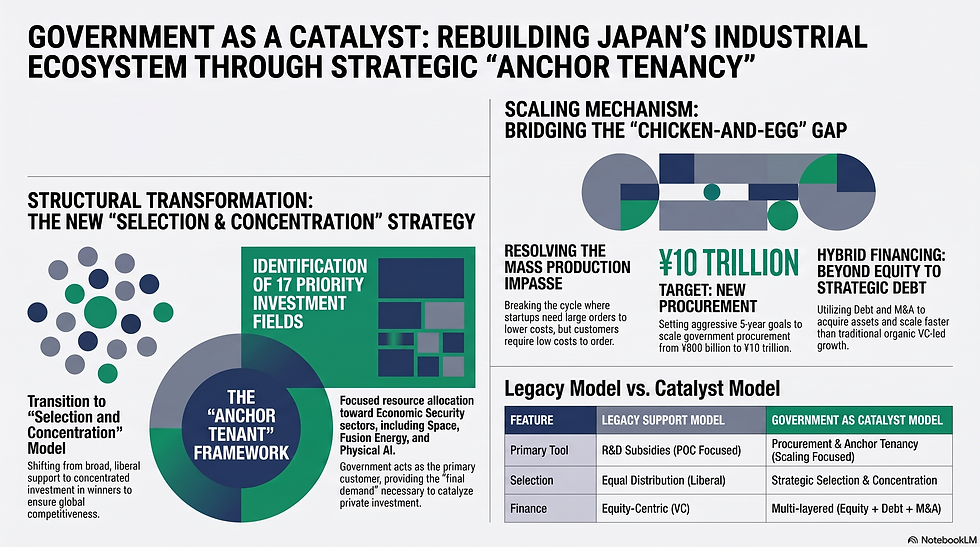
Together, they detailed how Japan is moving away from traditional, uniform research-and-development subsidies toward an aggressive "Anchor Tenancy" model—where the public sector and large corporations act as the crucial "first customer" to pull deep-tech startups across the commercialization gap.
1. From Digital Space to Physical AI: The Geopolitical Mandate
The panel opened by framing the macroeconomic forces reshaping the technology landscape. Kazuhiko Chuma of Mizuho argued that the era of unfettered global integration has ended, replaced by a "block-economy" reality driven by national security and supply chain sovereignty.
While the internet revolution of the past three decades was dominated by software giants in Silicon Valley operating entirely in the digital realm, Chuma emphasized that the next frontier is "Physical AI"—the integration of artificial intelligence and robotics into the physical world, including manufacturing, logistics, retail, agriculture, and primary industries.
Because Physical AI interacts directly with physical infrastructure, it is intimately tied to national security, supply chain resilience, and technological sovereignty. To secure its position, Japan has identified 17 Priority Investment Fields—ranging from defense modernization, nuclear fusion, and quantum technology to robotics and physical AI—where the state must actively co-invest and de-risk development.
2. The "Anchor Tenancy" Revolution: Bridging the Valley of Death
Historically, Japanese policy supported startups through broad, relatively even distributions of early-stage R&D grants under programs like NEDO and the Japanese SBIR. However, Hiroshi Ishikawa of METI acknowledged that this historical approach had a major limitation: public support traditionally stopped at the Proof of Concept (POC) stage, leaving startups stranded before they could achieve commercial scale.
Deep-tech ventures invariably face a classic "chicken-and-egg" dilemma (niwatori-tamago mondai) when attempting to scale:
The Volume Lock: Startups cannot achieve competitive mass-production pricing without a massive committed order from a client.
The Procurement Lock: Large corporate clients refuse to place large-scale orders until the startup can prove mass-production pricing and reliability.
To break this deadlock, Japan is transitioning to an "Anchor Tenancy" model. Under this framework, the government or anchor corporations step in as the "first customer", committing to purchase startup products at scale to absorb early deployment risks and establish viable market demand.
To operationalize this, METI is designing a matching mechanism: when a startup secures a Letter of Intent (LOI) from a buyer (either a government agency or a large corporation), the state will step in to subsidize and support the costs of deployment. The Japanese government has set an ambitious target under its Startup Development Five-Year Plan to expand wider public procurement from startups from the current 800 billion yen to 10 trillion yen.
3. The Global Power Game: Selection and Concentration
The panel was clear that deep tech is a high-stakes global power game where speed and capital density dictate survival. Jin Tomioka, CEO of Telexistence, contrasted Japan’s strategic realities with those of global competitors like China:
The China Model (Mass Volume): China funds multiple firms in parallel, running massive, capital-heavy races across various sectors to see who wins.
The Japan Model (Density): Lacking the sheer scale to replicate this approach across 47 prefectures, Japan must compete on "density." This means actively practicing "selection and concentration" to identify high-potential startups and aggressively backing them to maximize their scaling height.
Ishikawa compared this strategy to the NASA and SpaceX model in the United States, noting that NASA originally backed 20 companies through a rigorous stage-gate process, progressively narrowing the field down to two final competitors to create global champions. Japan intends to replicate this competitive filtering to foster its own national champions.
4. Redefining Scaling: "Swing-by IPOs" and Venture Debt
Hardware-heavy deep tech requires immense physical capital, prompting the panelists to challenge the traditional Silicon Valley equity-only venture model. Kazuhiko Chuma advocated for a "Japan-style" innovation model that leverages the massive, underutilized assets of traditional domestic corporations:
The "Swing-by IPO" Reimagined: Rather than viewing mergers and acquisitions (M&A) purely as an exit, Chuma redefined the "Swing-by IPO." In this model, a startup enters a large corporate group ("group-in") early in its lifecycle. By temporarily leveraging the parent enterprise's capital, manufacturing facilities, and client networks, the startup can rapidly scale past its unit-economics bottlenecks. Once mature, the startup can spin out and launch an independent IPO, utilizing the corporate group's gravity to accelerate its trajectory.
Acquiring SME Assets: Chuma noted a significant cultural hurdle: traditional Japanese small-and-medium enterprise (SME) owners historically viewed selling their business to a startup as a matter of "shame" (haji). Overcoming this mindset is crucial; startups should actively act as buyers, acquiring the manufacturing and quality control assets of succeeding-challenged SMEs to shave years off their own scaling timelines.
Venture Debt and the Valuation Trap: Relying solely on equity forces deep-tech startups to artificially inflate their valuations to avoid severe dilution. This overvaluation traps the startup, cutting off M&A flexibility. The panel advocated for a sophisticated "dual-track" financial strategy—recommending a mix of up to 40% venture debt once a startup achieves commercial predictability (backed by recurring RaaS contracts and backorders). This keeps valuations realistic while preserving options for both IPOs and strategic acquisitions.
5. The Public Element: The Moral Imperative of Deep Tech
The panel concluded on a philosophical but highly strategic note. Jin Tomioka argued that deep-tech ventures must remain grounded in their core purpose, continuously asking: "Why do we make this, and who actually uses it to improve society?"
Because deep tech addresses existential societal challenges—such as resolving severe labor shortages in logistics, convenience stores, and retail—it inherently contains a "public element". Tomioka emphasized that aligning a startup's commercial scaling with public welfare is not just an ethical choice, but a practical necessity; it is this fundamental alignment that unlocks deep collaboration between public policy, institutional finance, and private enterprise.


