

Newton and Archetype AI’s Vision for the Physical Economy
- Miki Sadinov
- 4 days ago
- 4 min read
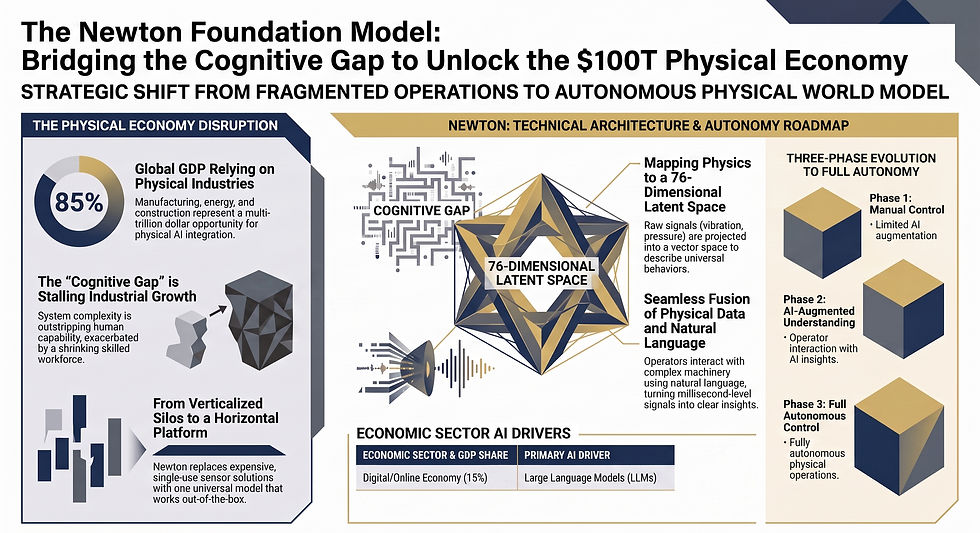
While the digital revolution has transformed online spaces and office workflows over the past few decades, its economic footprint remains concentrated. Generative AI tools and large language models (LLMs) operate primarily in the digital realm. In its market framing, Archetype AI positions roughly 85% of global economic activity as rooted in the physical world (spanning manufacturing, construction, energy, and transportation), compared with approximately 15% in primarily digital activity. This massive physical economy represents a multi-trillion-dollar opportunity for technological disruption, accelerating the race to build general-purpose physical artificial intelligence.
Founded in 2023, Archetype AI describes itself as a pioneer in Physical AI. The company has introduced "Newton," its proprietary physical-world foundation model designed to interpret diverse real-world sensor data and eventually automate complex physical systems.
The Challenges Plaguing Physical Industries
Modern heavy industries face existential bottlenecks that traditional digital software cannot solve:
The High Barrier to Robot Deployment: While humanoid robotics hold long-term promise, the timeline required to mass-deploy physical hardware globally is massive. Simply waiting for robots to solve physical automation is not a viable short-term strategy.
The "Cognitive Gap" and Labor Shortages: Industrial systems (like smart grids, chemical plants, and manufacturing lines) are growing exponentially complex. Human cognitive limits make real-time monitoring of these multi-dimensional systems incredibly difficult. This "cognitive gap" is worsened by severe labor shortages as younger generations migrate away from factory floors.
The Curse of Fragmented "Vertical" Solutions: According to Archetype AI's analysis, over 50% of the data generated by physical systems consists of multidimensional sensor readings and physical measurements, rather than text or video. To interpret this, companies historically relied on highly trained human specialists or expensive, siloed vertical software built for single sensors or specific use cases. These systems do not scale.
Archetype AI's approach bypasses these limitations by building a general-purpose horizontal platform designed to inject intelligence directly into existing infrastructure and sensor systems.
The Technical Architecture: Multimodal Fusion and Latent Representation
Newton is designed to bridge the gap between human instruction and physical machine behavior:
Multimodal Integration: Newton combines representations of physical sensor signals with language and other contextual modalities, allowing users to query and interpret real-world behavior.
Observational Learning over Hardcoded Rules: Rather than requiring engineers to pre-program complex governing equations or complete physical models for each asset, Newton learns patterns directly from observation to adapt dynamically to its environment in real-time.
Multi-Dimensional Latent Representation: Newton is a pretrained foundation model trained on diverse physical signals (such as vibration, temperature, pressure, and electrical currents). When it receives sensor data, it projects these inputs into a multi-dimensional representation vector (demonstrated in specific instances as a 76-dimensional space) within a shared latent space. This is conceptually similar to how language models represent words and concepts in an embedding space, but it is applied to patterns in physical signals—a concept the company describes as the "physical space".
Demonstration and State Mapping: From Sensor Signals to Operating Models
In practical demonstrations, Archetype AI has shown Newton's ability to map a system's state using an electric motor measuring speed and angle:
Real-Time Mapping: As the motor rotates, Newton receives raw sensor signals and projects the machine's state into the latent representation, visualizing distinct operating states and the transitions between them without human-coded rules.
Anomaly Detection: When abnormal variables (such as simulated friction, rattling, or sound anomalies) are introduced, Newton flags these unfamiliar observations in real time, clustering them separately from normal operating parameters.
State-Transition Mapping: After users label the identified operating states (such as "sliding," "drilling," or "non-drilling"), the system generates a map of transitions among those states directly from raw sensor data, generating a state-transition diagram that represents machine behavior. Archetype AI describes this generated framework of operating states as an "operational ontology" (or operating-state model) for the system.
With little or no task-specific fine-tuning in the demonstrations described, this single model operates across entirely different physical domains, including drilling operations, film-stretching processes, submersible pumps, wind turbines, and even human body motion analysis.
Edge Deployment and Natural-Language Interaction
Newton's architecture is designed to support edge and on-premises deployment for low-latency, secure decision-making. By combining the physical world model with language, the system powers conversational interfaces—such as its multimodal vision-and-sensor interaction systems.
In a demonstrated factory conveyor environment with multiple robot arms and motors, operators can query sensor data using natural language. For example, users can ask about the operational status of a robot arm or query temperature fluctuations. Newton translates high-frequency sensor readings (such as millisecond-scale physical signals) into clear natural language, acting as a Physical AI agent that translates machine signals into information operators can understand.
The Path to Autonomy
Archetype AI outlines a clear three-phase roadmap for physical operations:
Phase 1: Human-led operations supported by conventional automation: In this phase, humans are primarily responsible for controlling complex machinery and infrastructure, relying on conventional automation but struggling to keep pace with growing system complexity.
Phase 2: Augmentation (Near Future): The Newton model interprets raw, complex physical sensor data and translates it into natural language. This augments human understanding, enabling operators to make faster and better-informed control decisions, while ultimate physical control remains with the human.
Phase 3: Closed-Loop Control (The Long-Term Vision): Archetype AI’s long-term vision is to extend Newton from interpretation and decision support toward closed-loop, automatic control in selected physical systems. By closing the control loop, the foundation model could autonomously manage specific physical processes, reducing the need to build system-specific models from scratch or perform extensive manual retraining for each new deployment.
Conclusion: A Collaborative Frontier for Physical AI
The shift from manual, siloed vertical solutions to a unified horizontal intelligence platform represents a fundamental change in how heavy industries operate. By providing a pre-trained physical foundation model that adapts out-of-the-box to diverse environments—whether a construction site, a wind farm, or a high-tech manufacturing line—Archetype AI is unlocking the vast unstructured physical datasets that have historically been underutilized.
Rather than building custom models for every asset or waiting decades for advanced humanoid robots to populate factories, Newton offers a direct path to augmenting human capabilities today and paving the way for closed-loop machine autonomy tomorrow. To accelerate this transition, Archetype AI is actively seeking partnerships and collaborations with industrial leaders to carry out detailed joint research and run real-world implementations, turning the vast complexity of the physical economy into a collaborative frontier for intelligent automation.


