

The Billion-Cycle Loop: How Lightwheel Is Addressing Physical AI’s Data Bottleneck
- Miki Sadinov
- 4 days ago
- 4 min read
Introduction: The Rising Titan of Physical AI Infrastructure
In the rapidly accelerating race to develop physical AI and humanoids, a massive data bottleneck has emerged. While the industry has historically focused on building better hardware, the true battleground has shifted to the underlying data and evaluation infrastructure. Leading this paradigm shift is Lightwheel, a Physical AI simulation and data-infrastructure startup founded three years ago, which secured approximately $100 million in customer orders during Q1 2026.
Founded by Steve Xie, Ph.D., who previously led autonomous-driving simulation at NVIDIA and simulation at Cruise, Lightwheel focuses on simulation, data, evaluation, and deployment infrastructure for Physical AI. The company counts frontier Physical AI organizations like Google DeepMind, as well as global industrial and manufacturing leaders such as Samsung, Toyota, and BYD, among its clients and key partners. Lightwheel's simulation and Real-to-Sim work has been featured in NVIDIA ecosystem events and GTC programming.
Why Physical AI Demands Orders of Magnitude More Data Than Driving
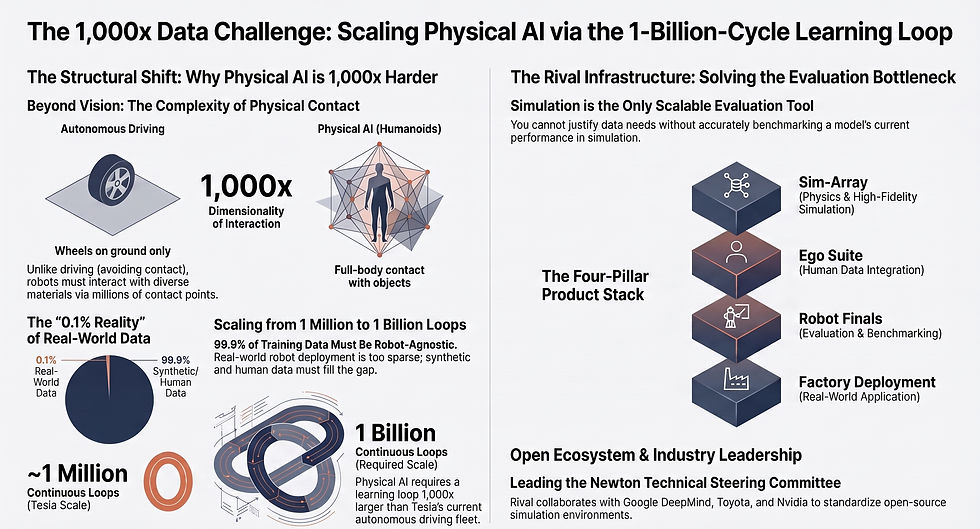
Steve Xie argued that physical AI may require orders of magnitude more interaction data than autonomous driving. This disparity stems from two fundamental differences:
The Absence of "Free" Pre-training Data: Large Language Models (LLMs) benefit from massive, freely available pre-training datasets harvested from the internet. Similarly, in the automotive sector, Tesla benefits from a large deployed vehicle fleet that continuously generates real-world driving data without requiring a separate robotics data-collection fleet. Physical AI and humanoids possess no such default, real-world data resource; every byte of interaction data must be actively designed and acquired from scratch.
The Dimensionality of Physical Contact: Compared with manipulation, autonomous driving generally involves a more constrained interaction space in which direct physical contact is normally avoided. In normal operation, autonomous vehicles are designed to minimize contact with external objects, while manipulation robots must intentionally make and control contact through hands, grippers, tools, and feet. This deliberate interaction involving fingers, palms, and soles with an endless variety of materials exponentially multiplies the degrees of freedom and data dimensions.
The 99.9% Shift: Embracing Robot-Agnostic Data
Many robotics companies are attempting to bypass the data shortage by collecting data directly from physical robots, but this approach faces a harsh reality. Because mass-scale robots are not yet deployed in households or factories, real robot data is hard to come by. Xie estimated that directly collected robot data may represent only a very small share (approximately 0.1%) of the total data required, with synthetic and human-derived data providing the vast majority (99.9%) of the scale.
Consequently, the vast majority of training data must be supplied through "robot-agnostic" channels. Lightwheel defines robot-agnostic data as generalized training inputs not bound to a single robot embodiment, which includes:
High-fidelity synthetic data and trajectories
Egocentric human motion data and video captured from first-person perspectives
Environment data and generalized task representations
To manage this, data can no longer be treated as static datasets like Fei-Fei Li’s pioneering ImageNet (Data Phase 1) or as purely labeled assets managed by data operations firms (Data Phase 2). Physical AI requires transitioning to Data Phase 3: Evaluation-Driven Continuous Learning, where active feedback loops constantly drive new synthetic data requirements based on failures.
While Tesla pioneered this continuous loop in the real world using millions of vehicles via its "shadow mode," physical AI requires an even more ambitious scale. Tesla operates its loop on a scale of one million physical vehicles on the road; physical AI demands a one-billion-cycle continuous learning loop. By a "cycle," Xie refers to one complete simulation-and-evaluation episode (such as a single policy rollout under varying environmental conditions), rather than one physical robot or a single piece of recorded data.
The True Bottleneck: Evaluation, Not Data
While the industry frequently complains of a "robotics data bottleneck," Lightwheel argues that evaluation—not data volume alone—is the central bottleneck. Developers need reliable feedback about where models fail before they can decide what additional, targeted data to generate.
However, with a negligible number of physical robots deployed in the wild, executing a real-world "shadow mode" evaluation like Tesla's is physically impossible.
Simulation is one of the only approaches capable of delivering evaluation at the scale, diversity, and repeatability required for rapid iteration. High-fidelity simulation offers:
Massive Scale: The ability to run millions of parallel tests daily.
Environmental Diversity: Testing robot models in 10,000 completely different homes or factories simultaneously.
Reproducibility: Controlled and reproducible test conditions across evaluation runs to measure incremental progress.
Low Latency: High-throughput feedback loops that instantly inform model training.
The challenge, however, is not merely running more simulations, but overcoming the sim-to-real gap. Lightwheel emphasizes that simulators must be carefully calibrated so that simulated rankings and failure patterns reliably predict real-world robot behavior.
Lightwheel's Core Infrastructure Suite
To bind data, evaluation, and deployment into a single, high-speed continuous learning loop, Lightwheel offers four flagship products:
SimFoundry: The simulation foundation of Lightwheel's stack, utilizing a solve-measure-generate workflow. It integrates advanced physics solvers and automated environment generation with physical measurement laboratories. These facilities measure real-world physical properties—such as friction, elasticity, and mass—to incorporate them into simulation, improving realism and sim-to-real predictivity. Lightwheel is currently constructing over ten of these facilities globally.
EgoSuite: A massive, high-quality platform and dataset of egocentric (first-person) human actions tailored for foundation models and robotics.
RoboFinals: Lightwheel’s scalable, simulation-based evaluation platform running on NVIDIA Isaac Lab-Arena, supporting large-scale evaluation of robotics policies.
RoboStack: A specialized deployment infrastructure designed to rapidly transition simulation-proven models into real-world factory environments and feed deployment data and failure cases back into the simulation loop.
Cultivating an Open Real-to-Sim Ecosystem
Recognizing that a billion-cycle continuous learning loop cannot be realized by a single corporation, Lightwheel is actively championing an open development ecosystem.
The Newton project was co-developed by NVIDIA, Google DeepMind, and Disney Research, and subsequently contributed to the Linux Foundation. Lightwheel has established itself as a core advisor associated with Newton, participating alongside the Toyota Research Institute (TRI).
Within this framework, Lightwheel is committed to contributing its GPU-accelerated physics and simulation tools, standardized simulation environments, and selected physical-property measurement assets. This collaboration will ensure that developers worldwide have access to GPU-accelerated, open-source, and physically grounded simulation tools, accelerating the arrival of truly capable physical AI.


