

The Battle for Digital Sovereignty: How Japan is Transforming Domestic Cloud and AI into National Infrastructure
- Miki Sadinov
- Jul 19
- 5 min read
In an era where frontier artificial intelligence models and cloud architectures are no longer just drivers of corporate efficiency but critical instruments of national security, Japan is executing a quiet but ambitious revolution.
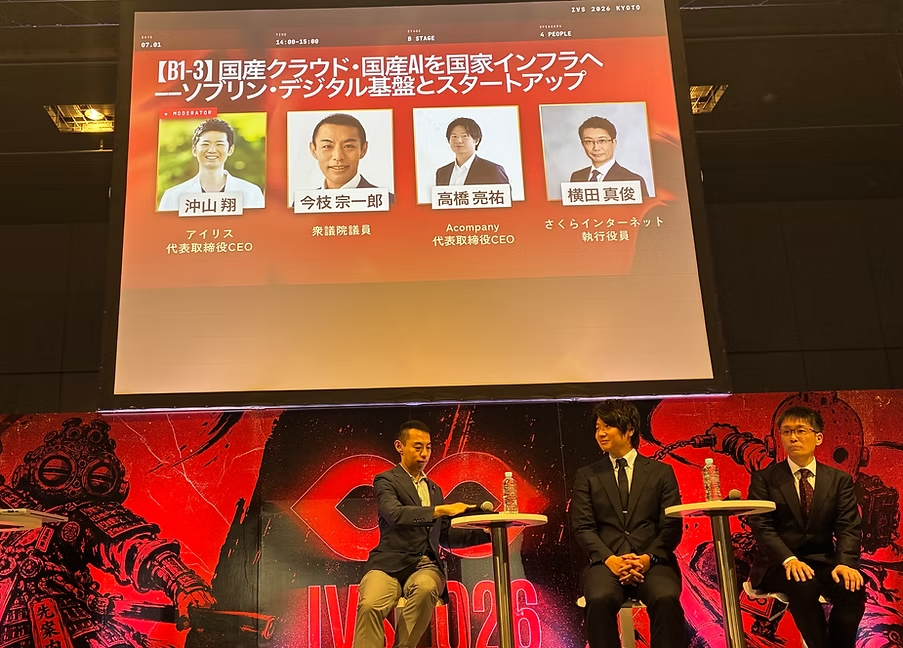
At the recent IVS2026 panel titled "Domestic Cloud and AI as National Infrastructure — Sovereign Digital Foundations and Startups," key leaders from Japan’s public sector, infrastructure giants, and deep-tech startups converged to outline the nation's blueprint for technological self-reliance.
The panel featured:
Soichiro Imaeda, Member of the House of Representatives, State Minister for Digital Affairs, and State Minister of the Cabinet Office;
Masatoshi Yokota, Executive Officer in charge of the Cloud Business Strategy Division at Sakura Internet Inc.;
Ryosuke Takahashi, Representative Director and CEO of Acompany Co., Ltd., and President of the Privacy Tech Association;
Sho Okiyama (Moderator), Representative Director of Jaris Co., Ltd., and Representative Director of the AI Safety Promotion Organization.
Together, they detailed a shifting geopolitical landscape, major national security milestones, and a massive investment roadmap designed to position Japan as a global anchor of trusted digital infrastructure.
The Geopolitical Wake-Up Call: The Risk of Foreign Dependence
The urgency surrounding sovereign AI and sovereign cloud has intensified following sudden international developments. For years, domestic stakeholders warned about the risks of absolute reliance on foreign hyperscalers. Recently, those theoretical risks became a harsh reality.
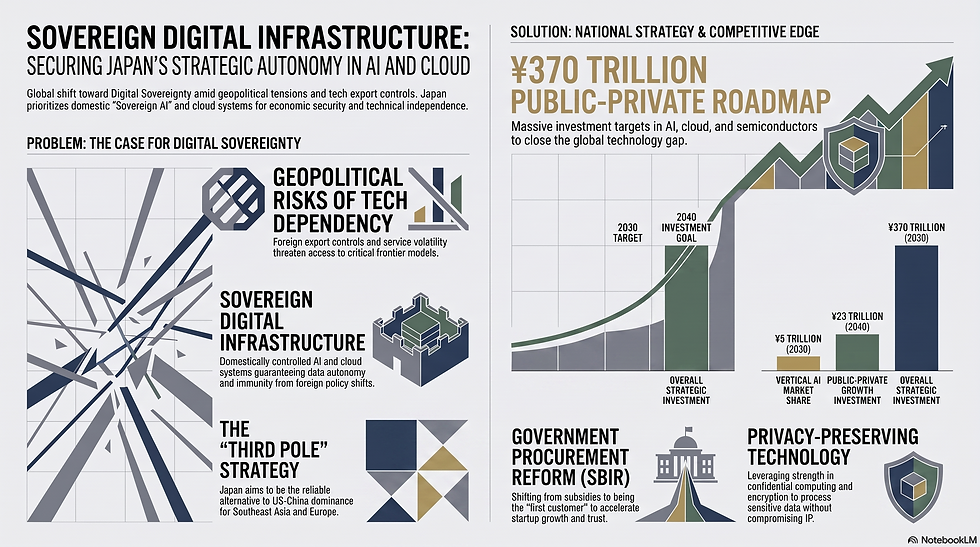
Sudden Technology Controls: The panel cited recent U.S. technology-control measures as evidence that access to advanced AI capabilities can be constrained by nationality, location, or export-control policy. State Minister Soichiro Imaeda highlighted reports that regulatory restrictions have limited advanced model access even for non-U.S. citizens physically present inside U.S. borders.
The Vulnerability of Convenience: Japan has experienced firsthand the fragility of foreign tech dependence. When access to cutting-edge models is abruptly throttled due to changing foreign policies, Japanese companies and public services face immediate operational risks.
The Control Mandate: As Masatoshi Yokota of Sakura Internet emphasized, the goal is not to force domestic users onto inferior systems, but to build and preserve the sovereign engineering capacity and control rights to run, modify, and secure key digital infrastructure within Japan.
Japan as the 'Third Pole' of Trust
While the United States and China remain the undisputed tech giants, Japan is carving out a highly strategic geopolitical role: the Third Pole.
According to State Minister Soichiro Imaeda, there is a growing interest among European and Southeast Asian governments that are reluctant to align exclusively with either American or Chinese tech ecosystems. Based on his cabinet-level international interactions, including G7 ministerial meetings, Imaeda noted that Japan is increasingly viewed as a neutral, stable, and highly trustworthy alternative.
Japan’s Full-Stack Capabilities
Ryosuke Takahashi of Acompany outlined a rare, complete domestic stack that positions Japan uniquely in this geopolitical competition:
Hardware Manufacturing: Next-generation supercomputer processors designed by Fujitsu and advanced silicon foundry initiatives like Rapidus.
Cloud Foundations: Robust, independent domestic cloud platforms like Sakura Internet.
Data Security Layers: Confidential computing and secure computation technologies to process highly sensitive data.
System Integration: Experienced domestic system integrators capable of seamlessly unifying these complex layers.
Pioneering Initiatives: From Government Cloud to GENAI
Japan’s strategy is not merely theoretical; it is already backed by concrete, operational milestones.
1. Sakura Internet’s Government Cloud Milestone
In a monumental shift for domestic infrastructure, Sakura Internet was formally selected as a provider for Japan’s Government Cloud.
The Challenge: To qualify, Sakura Internet had to satisfy more than 300 rigorous technical criteria established by the Digital Agency.
The Comparative Scale: Yokota compared the technical demand of the process to being asked to "build AWS from scratch in two years."
Rapid Engineering: Having met only about one-third of the requirements three years prior under a conditional selection phase, Sakura’s engineering team successfully developed and deployed the remaining two-thirds of the features to satisfy all criteria, achieving formal selection in March 2026.
2. Deploying and Open-Sourcing Government AI "GENAI"
The Digital Agency is spearheading the deployment of its custom-built generative AI system, Government AI "GENAI" (pronounced "Gennai").
Rollout and Open-Source Strategy: In April 2026, the Digital Agency released part of GENAI as open-source software and announced a large-scale fiscal year 2026 rollout covering approximately 180,000 employees across government ministries and agencies.
International Collaboration: According to the panel, the government is also exploring discussions with foreign governments to support deploying GENAI within their own sovereign environments, potentially paving the way for Japanese technology providers to expand globally.
3. Acompany and the Rise of Privacy Tech
To secure highly sensitive data (such as financial and medical records) without stifling AI development, Japan is leaning heavily into Privacy Tech.
University Origins: Founded in 2018 as a startup out of Nagoya University, Acompany is deploying confidential computing and secure computation. This technology keeps data encrypted even during active processing.
Securing Global IP: Takahashi highlighted how confidential computing can structurally protect intellectual property. In prospective deployment models, this technology could enable foreign frontier-model companies to securely deploy their protected IP inside Japan, or conversely, allow Japanese models to be securely exported to foreign sovereign environments without risking code or weight leakage.
Overcoming the "Zero-Risk" Mindset and Reforming Procurement
For Japan to truly thrive, its leaders are advocating for a dramatic cultural shift away from paralyzing risk-aversion toward proactive innovation.
Reinterpreting Personal Information Protection: Moderator Sho Okiyama pointed out that Article 1 of Japan's Act on the Protection of Personal Information refers both to protecting individual rights and to considering the utility of personal information, showing that the original legislative intent balances privacy protection with beneficial data utilization.
Rethinking SBIR and Government Procurement: State Minister Imaeda critiqued past initiatives like the Japanese Small Business Innovation Research (SBIR) program for functioning more like subsidies than actual revenue-generating customer contracts. To address this, Imaeda highlighted a major procurement reform proposed by his coalition to position the government as the "first customer" for deep-tech startups, providing immediate commercial validation.
The Growth Vision under the Takaichi Administration
Looking forward, Japan’s digital trajectory is backed by unprecedented fiscal and political commitment. State Minister Imaeda pointed to the newly established administration of Prime Minister Sanae Takaichi, noting her strong personal commitment to sovereign digital technology and a responsible, proactive fiscal policy as the driving force behind these ambitious digital targets:
Massive Sovereign Capital: A long-term growth roadmap seeking 23 trillion yen in public-private investment by 2040 dedicated to domestic AI and sovereign cloud development.
Dominating Vertical AI: An ambitious policy target for Japan to capture at least 5 trillion yen of a projected 33 trillion yen global vertical AI market by 2030.
Coordinated Ecosystem Growth: Leveraging domestic chips, domestic clouds, and secure computational layers to establish an unbreakable, virtuous cycle of technological development.
A Stature of Global Leadership
As the panel concluded, the moderator called upon the audience to rise and applaud the speakers, resulting in a warm standing ovation from the IVS2026 crowd. The message was clear: sovereign AI and cloud infrastructure are not merely defensive plays to protect Japan’s borders. By focusing on trust, deep security, and collaborative open-source diplomacy, Japan is actively building the digital foundations of a safer, more balanced global tech ecosystem.


