

The Realities of the Late Stage: Startup CFOs on Valuation Resets, P&L Reshaping, and the IPO Dilemma
- Miki Sadinov
- Jul 19
- 5 min read
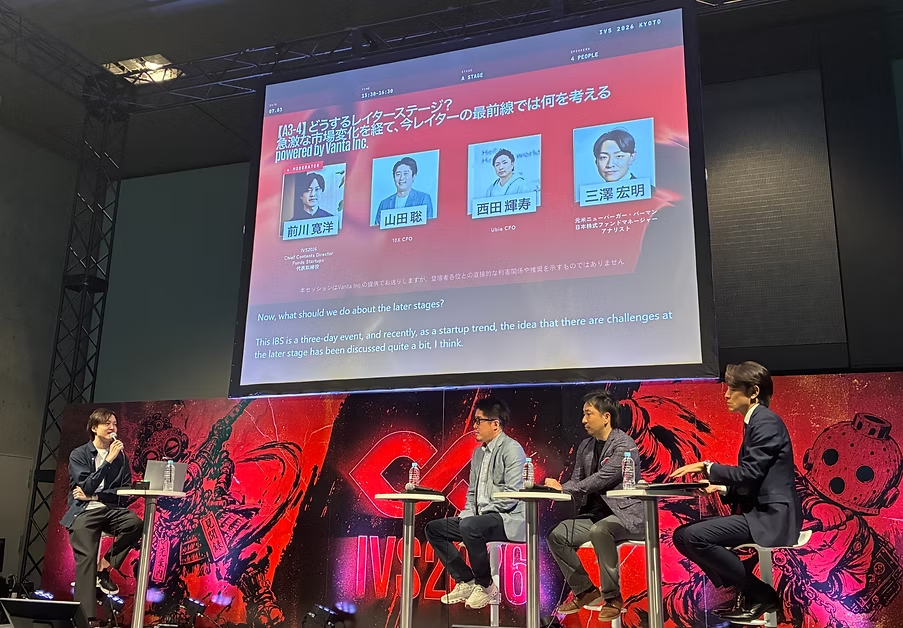
The macroeconomic shifts of the past three years have fundamentally rewritten the playbook for late-stage startups. In a candid panel discussion at IVS2026, startup CFOs and a crossover investor pulled back the curtain on the intense, often painful, decisions required to navigate today’s capital markets.
The panel was moderated by Hirohiro Maekawa, Representative Director and Chief Contents Director of Funds Startups, and featured:
Satoshi Yamada, CFO of 10X, Inc., a retail-technology company providing the Stailer retail-DX platform, currently in its ninth fiscal year since founding; formerly at the Carlyle private equity fund.
Teruhisa Nishida, CFO of Ubie, Inc., a healthtech and AI company; with a background of over a decade in banking and securities.
Hiroaki Misawa, a veteran crossover investor, institutional asset manager, and former startup CFO, who previously served as a Japanese equity fund manager and analyst at the US-based asset management firm Neuberger Berman.
Here are the key insights and strategic takeaways from their discussion on capital policy, restructuring, and the true meaning of business value.

1. Redefining the Late Stage: Moving Beyond Series Labels
In the current environment, traditional venture capital round labels (Series A, B, C) have lost their utility. The panelists argued that conventional Series A, B, and C labels reveal less about business maturity than profitability, predictability, and financing needs.
The Valuation and Profitability Thresholds: Yamada argued that a genuinely late-stage company should have a credible path to a public-market valuation of roughly ¥10 billion to ¥20 billion, even under less favorable market conditions. Furthermore, even if not yet fully profitable, the business must have a visible path to generating ¥1 billion to ¥2 billion in operating profit.
Business Model Predictability: Misawa defined the late stage as the point where the company's core business model is established and the main axis of the business no longer wavers, meaning the phase of major strategic pivots is behind them and future growth becomes highly predictable.
The Danger of Pre-IPO Diversification: Misawa cautioned late-stage startups against launching into entirely new domains or pursuing acquisitions designed solely to manufacture short-term growth. He emphasized that crossover investors prefer startups to focus entirely on scaling their proven core model before going public, though he noted that acquisitions with genuine synergy to expand the core business remain a valid consideration.
2. Treating Down Rounds as a Strategic Option
One of the most striking segments of the panel was Yamada's pragmatic stance on down-rounds.
In 2021, 10X secured ¥1.5 billion in funding at a valuation of ¥15 billion. However, as the macroeconomic environment shifted, the company realized its growth rate could not easily justify that valuation under new market terms. Instead of stalling or trying to paper over the gap, 10X chose to actively restructure.
Embracing Fair Value Resets: Yamada emerged as a strong advocate for resetting to market-supported valuation (which Yamada referred to as "fair value"), calling himself a "down-round supporter" (down-round sansei-ha). He argued that delaying a valuation reset only creates structural distortions that ruin a company during or immediately after its IPO.
Negotiating with the Market: To find their true market price, 10X pitched to and gathered valuation feedback from over 50 potential investors, using the real-time feedback to establish a realistic valuation range. Yamada then transparently shared this market reality with existing shareholders to align expectations.
Optimizing the Shareholder Base via Secondaries: 10X actively proposed and negotiated secondary transactions from its own side to restructure the cap table, replacing investors who could not hold through a longer 5-to-10-year horizon with long-term capital partners.
"If you think that valuation is too cheap, then you should write the check [and invest additional capital] yourself." — Satoshi Yamada, CFO of 10X, describing his discussions with existing investors (which he noted having to reiterate about ten times)
3. Reshaping the P&L: Generative AI and Radical Transparency
For companies that choose to continue investing heavily for growth, the pressure to reform the Profit & Loss (P&L) statement is immense.
Ubie’s Structural Shift via Generative AI
Ubie CFO Teruhisa Nishida shared how his company is deploying generative AI to structurally transform its P&L. While maintaining active growth investments, Ubie uses AI to drive operational efficiencies:
Operational Efficiency: Nishida noted that Ubie is exploring whether generative AI could eventually enable the company to support comparable revenue with a substantially leaner workforce. He shared his personal estimate that the company could potentially achieve its current revenue levels with approximately half of its human headcount, and noted that Ubie is actively taking organizational steps toward realizing this efficiency.
Product Enhancements: Beyond internal productivity, generative AI has been integrated directly into Ubie's core clinical-support and symptom-intake system, AI Monshin (AI問診). Nishida reported that introducing generative AI to upgrade user interfaces and expand clinical-support tools for nurses and administrative staff has significantly increased adoption of these systems within medical institutions.
Internal Communication and Motivation
Managing costs requires deep alignment within the organization. The CFOs shared distinct approaches to driving cost consciousness among non-financial employees:
Connecting Infrastructure Costs to Share Options: Yamada described using valuation-based examples to show employees how recurring infrastructure savings could increase enterprise value and, indirectly, the value of their stock options. At 10X, where stock options are distributed to all employees, Yamada explicitly connects daily cost-saving measures to equity value, explaining to site reliability engineering (SRE) team members that a hypothetical 5% reduction in server costs can translate to a ¥1 billion positive impact on the company's valuation.
Radical Financial Transparency: Ubie maintains a highly transparent internal data policy where corporate metrics, including monthly bank balances and expenditures—excluding restricted customer data and information subject to legal or compliance guidelines—are open to any employee. However, Nishida noted that transparency alone does not guarantee engagement, estimating that perhaps fewer than 10% of employees actively monitor these monthly cash figures, meaning the CFO must still constantly translate financial data into localized, department-specific goals.
4. The Public Market Transition: Confronting Investor Realities
A recurring theme was the friction between private startup enthusiasm and the cold, analytical reality of public market investors.
The Comparative Focus of Public Markets: Misawa observed that public-market investors tend to approach companies through portfolio construction and comparative returns rather than the long-term relational commitment often associated with venture investing. He noted that public market managers oversee hundreds or thousands of alternative stocks and allocate capital where it yields the highest return at any given moment.
The IPO Dilemma: Yamada questioned whether some profitable software companies benefit from listing if doing so subjects them to earnings expectations that conflict with their preferred investment horizon. With Japanese unlisted financing markets expanding dramatically over recent years, rushing to an IPO to satisfy public market investors who demand short-term earnings can lead to a strategic dead end.
Bridging the Gap: Both CFOs emphasized the importance of proactively meeting public market and crossover investors several years in advance or one to two stages ahead of a planned IPO. These meetings serve as a reality check for the startup's valuation and business plan, allowing the leadership team to align internal projections with external market expectations.
Conclusion: The "Cool Head and Warm Heart" of the Late Stage CFO
The panel concluded with a reminder of the unique, bridging role that a late stage CFO must play. Nishida summarized the role as one of continuous objective self-reflection—balancing the emotional drive that fuels startup innovation with the pragmatic metrics demanded by global financial markets.
Misawa noted that late stage CFOs must exist in the balance "between a cool head and a warm heart"—holding onto the company's core mission and passion while remaining entirely sober about valuation, capital efficiency, and market realities.


