

Escaping the Pilot Trap: How Manufacturing Leaders Are Scaling AI
- Miki Sadinov
- Jul 4
- 5 min read
Session: From pilot to production: How industrial leaders are scaling AI across global manufacturing.
Speakers:
CK Kumar — Director, Edge Marketing, Dell Technologies (Moderator)
Jason Nassar — Vertical Enablement Leader, Product Management, Dell Technologies
Ralf Schulze — VP Physical AI, HCLTech
Jessica Bethune — Vice President Industrial Automation DACH, Schneider Electric
Sean Young — Director, Enterprise Marketing, NVIDIA Headquarters
Summary:
This panel addresses the manufacturing "outcome gap," exploring why approximately 33% of industrial AI pilots stall before reaching full-scale production. Industry experts identify the IT/OT culture clash, infrastructure bottlenecks, and lack of executive support as the primary barriers to scaling. To successfully transition to global production, leaders must leverage digital twins for safe simulation, adopt automated deployments, and immediately upgrade legacy systems.

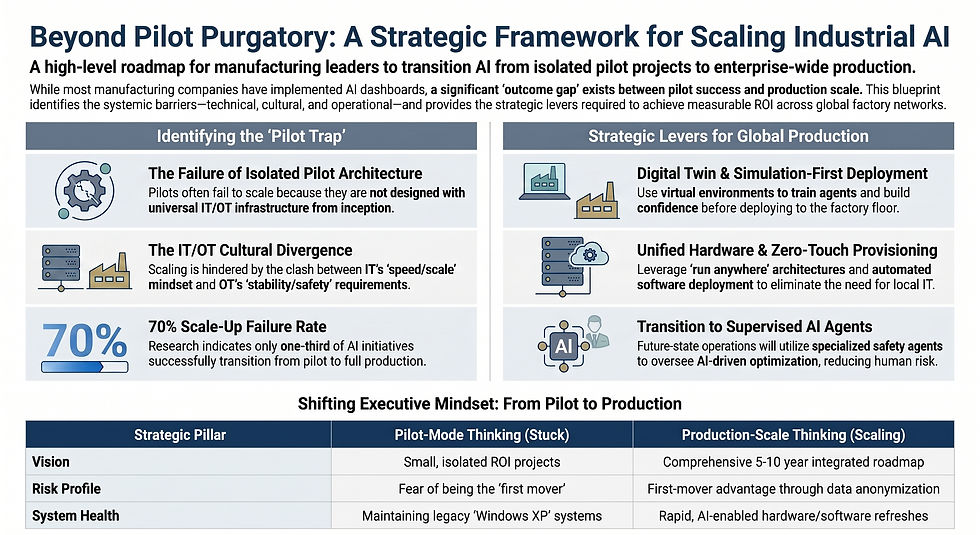
While most global manufacturers have successfully deployed AI dashboards, a vast majority struggle to translate these initial experiments into full-scale production. This disconnect has created a critical "outcome gap" on the factory floor, with industry research indicating that approximately 33% of industrial AI pilots stall. To overcome this hurdle, manufacturing leaders must move beyond comfortable proof-of-concepts and embrace the strict organizational discipline required for true enterprise-scale deployment.
At a recent Hannover Messe panel discussion moderated by CK Kumar (Director, Edge Marketing, Dell Technologies), industry experts dissected why scaling attempts fail and mapped out a concrete strategy for transitioning AI from localized pilots to global production lines.
Redefining the Shift from Pilot to Production
According to the panel, an AI initiative officially graduates from pilot status and enters true production when it crosses several systemic and operational thresholds:
Global Scalability: Jason Nassar (Vertical Enablement Leader, Product Management, Dell Technologies) notes that while pilots frequently succeed in small, isolated work centers, true production is only achieved when the solution can be successfully deployed throughout an entire factory and subsequently scaled across multiple global facilities.
Measurable Business Outcomes: Jessica Bethune (Vice President Industrial Automation DACH, Schneider Electric) defines production-scale AI as the moment the technology delivers repeatable, measurable results—such as optimizing product yield or reducing operational downtime.
Systemic Integration and Change Management: Ralf Schulze (VP Physical AI, HCLTech) explains that scaling requires deep systemic integration and organizational change management at the operational level to ensure the technology continuously delivers tangible value.
Real-Time Autonomous Decision-Making: Sean Young (Director, Enterprise Marketing, NVIDIA Headquarters) envisions an environment where every asset—robots, cameras, IoT sensors, and PLC controllers—is interconnected. True production AI observes these massive datasets in real time to make autonomous decisions, correct errors, and optimize system efficiency at a scale humans cannot replicate.
The Root Causes of Stalled AI Pilots
The panel identified four critical bottlenecks that frequently halt the momentum of industrial AI initiatives:
The IT vs. OT Culture Clash: Bethune identifies cultural misalignment as the single greatest threat to project success. IT departments prioritize rapid deployment, speed, and scalability, whereas Operational Technology (OT) teams prioritize stability, accountability, and physical safety. In high-stakes environments like refineries, an unverified IT-driven algorithm that incorrectly alters pump pressure can cause catastrophic, life-threatening explosions, reminiscent of the Deepwater Horizon disaster.
Hidden IT Infrastructure Bottlenecks: Nassar explains that organizations often succeed in analyzing OT data at a single site, but realize too late that scaling requires a massive overhaul of IT equipment, gateways, and servers at every subsequent location. Without an upfront scaling plan, companies find themselves completely redoing the pilot at each new site.
The Complexity of Factory Simulation: Young notes that while simulating single-product physics is common, a factory floor is an infinitely complex environment involving liquids, thermals, vibration, and noise. Simulating machines or PLC controllers from different vendors independently fails to optimize the system; scaling requires solutions that can simulate the entire factory from a systems engineering perspective.
Technology Focus vs. Long-Term Strategy: Schulze argues that modern cloud, on-premise, and edge computing technologies are already mature enough to handle these complexities. Projects stall because companies launch isolated pilots to "test the waters" rather than defining a 5-to-10-year strategy and executing it in incremental, practical steps.
Bridging the Gap: Digital Twins and Autonomous Agents
To safely transition AI models to the physical factory floor, manufacturers are increasingly relying on simulation and digital twins as critical validation grounds.
Virtual Training Environments: Young explains that in highly complex factory settings, humans are a safety bottleneck because they cannot process massive streams of PLC and sensor data quickly enough to prevent accidents. Training AI within a digital twin allows the model to make mistakes in a virtual environment where errors do not cost profits or human lives, building organizational confidence before physical deployment.
Predictive Maintenance in Action: Bethune shares that feeding digital twins with real-time data allows systems to monitor asset health and conduct advanced condition-based maintenance. A current Schneider Electric customer uses this technology to achieve a three-month lead time on machine failure predictions, actively saving lives in hazardous refinery environments.
Supervised and Safety Agents: As AI systems mature, Bethune predicts a transition to "supervised agents". Operational agents will optimize machinery, while dedicated "safety agents" oversee the system, eventually allowing human operators to step back entirely.
Escaping the Pilot Trap: A Blueprint for the Next 90 Days
To break out of the AI pilot trap and prepare for an automated future where AI will drive nearly half of all automation revenues by 2030, the panelists delivered a direct call to action for manufacturing leaders:
Stop Waiting for First Movers: Bethune urges manufacturers to stop waiting for competitors to take the first risk. Leaders must overcome their hesitation to anonymize and share data, as engaging with new technologies is the only way to develop cutting-edge capabilities.
Stop Chasing Technology for Its Own Sake: Schulze compares technology obsession to getting an X-ray simply because you like the machine; the true goal is the diagnosis and treatment. Leaders must define their long-term strategic goals and break them down into tangible technical steps rather than launching pilots based on market hype.
Stop Running Small, Unbudgeted Projects: Young warns that small, uninspiring pilots lacking executive support or a clear ROI vision lead to the adoption of fragile, "Scotch-taped" systems that cannot scale. Secure executive sponsorship, establish a robust budget, and select scalable technologies from the outset.
Eliminate Legacy System Excuses: Nassar emphasizes that keeping outdated legacy systems (such as Windows NT or Windows XP) on the factory floor because "they work right now" is no longer a viable excuse. Modern AI enables these legacy systems to be replaced and upgraded in days rather than months.
Standardize Zero-Touch Provisioning: To scale predictably, Nassar advises designing edge deployments that mimic a "consumer electronics experience". Devices should be plugged in on the factory floor, automatically load their software, and run under zero-trust security without requiring local IT personnel to be deployed at each site.
Start Simple with AI Vision: For an immediate win, Young suggests downloading NVIDIA's VSSS (Video Safety, Security, and Services) blueprint to connect factory cameras to edge computers, utilizing foundation models for immediate real-time video analysis.


