

Forging Europe's New Defense Industrial Landscape: Finance, Innovation, and Strategic Capacity
- Miki Sadinov
- Jun 25
- 5 min read
Session: European Defence: How we build the industrial landscape we need
Speakers: ・Dr. Michael Schöllhorn Chief Executive Officer Airbus Defence and Space
・Jan Hesthaven President Karlsruher Institut für Technologie (KIT)
・Robert de Groot Vice-President European Investment Bank
・Sven Weizenegger Head of Cyber Innovation Hub Cyber Innovation Hub der Bundswehr, BWI GmbH Session Summary: This panel explores practical strategies to modernize Europe's defense industrial base by accelerating production and integrating agile startups into military procurement. Experts emphasize the need for unified pan-European financing, collective cross-border procurement, and closing the gap between academic research and military applications. Ultimately, the goal is to build strategic "installed capacity" and robust societal resilience to effectively deter geopolitical threats.

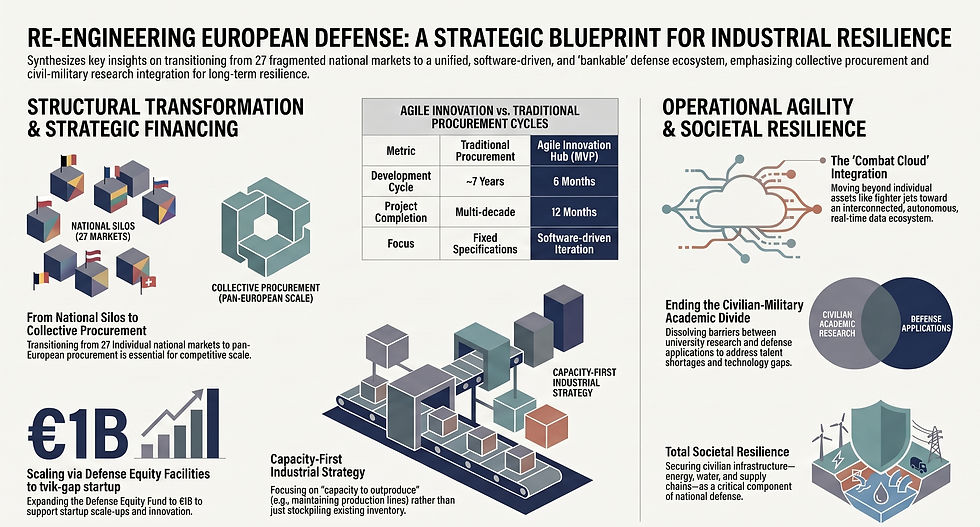
In a rapidly shifting geopolitical climate, European leaders across finance, academia, and industry are converging to rebuild and modernize the continent's defense industrial base. During a recent high-level panel discussion, experts explored the practical, actionable steps required to accelerate defense production, integrate agile startups into military procurement, and securely finance European defense initiatives. Featuring insights from Robert de Groot of the European Investment Bank (EIB), Professor Dr. Jan S. Hesthaven of the Karlsruhe Institute of Technology, Sven Weizenegger of the German Armed Forces' Cyber Innovation Hub, and aerospace industry executive Michael Schöllhorn, the consensus is clear: Europe possesses the industry, technology, and innovative environment necessary to succeed, but it must urgently scale up and accelerate its efforts.
The Financial Paradigm Shift
A major historical hurdle faced by the European defense sector was the deep reluctance of financial institutions to fund military procurement, a stigma that has dramatically reversed over the past two years. Robert de Groot, Vice President of the EIB, noted that commercial banks, insurers, and pension funds are actively changing their policies to support defense needs.
However, public institutions like the EIB require "bankable projects," meaning the financed initiatives must generate reliable cash flows to repay loans with interest. To overcome market fragmentation and successfully finance industrial scale-ups, de Groot emphasized the critical need for a unified pan-European capital market and collective, cross-border procurement.
Key takeaways on defense financing include:
Cross-Border Procurement: Transitioning away from 27 fragmented national procurement systems toward collective European purchasing is essential for achieving competitive production scales and market efficiency.
Defense Equity Fund 2.0: Building on the success of an initial €175 million defense equity facility, the European Investment Fund is launching a second fund aiming for at least €1 billion to help startups and mid-sized companies scale up significantly.
Civilian Resilience Financing: The EIB continues to invest heavily—distributing about €100 billion in loans annually—into resilient civilian infrastructure such as energy grids, renewables, and hospitals. This infrastructure is crucial for logistical military support and defending society against hybrid threats, such as drone attacks on water and power supplies.
Bridging the "Valley of Death" with Agile Innovation
Traditional defense procurement timelines, which often span up to seven years in peacetime, are no longer viable for modern conflicts. Sven Weizenegger of the Cyber Innovation Hub highlighted the necessity of rapid iteration, pointing out that modern warfare is fundamentally driven by software. By empowering everyday soldiers to act as entrepreneurs who identify operational problems, the Hub connects military needs directly with the startup ecosystem to create rapid software and hardware solutions.
Key innovations in procurement include:
Accelerated Timelines: The Cyber Innovation Hub operates on aggressive metrics, aiming to deliver a Minimum Viable Product (MVP) within six months and a final project result within a single year.
Dedicated Scaling Budget: To cross the "valley of death"—the notorious gap between an initial MVP and large-scale military procurement—the German parliament recently tripled the Hub's budget to €40 million. This enables the immediate scaling of successful products to front-line soldiers within two to three years, completely bypassing traditional bureaucratic delays.
Front-Line "Spark Cells": To foster an agile mindset globally and solve local problems at scale, the Hub is deploying 25 "spark cells"—dedicated innovation units—directly within armed forces units this year.
FCAS and Strategic Installed Capacity
Addressing the heavy industrial side of defense, industry executive Michael Schöllhorn discussed the Future Combat Air System (FCAS). He clarified that FCAS is far more than just a next-generation fighter jet; at its core is a "combat cloud" that allows various assets, including drones and satellites, to connect in real-time, maintain redundancy, and operate autonomously if ground communication is lost. Schöllhorn stressed that the development of this combat cloud must begin immediately, rather than waiting for the 2040 target date of the sixth-generation fighter.
Key industrial strategies include:
Cooperative European Fighter Programs: Schöllhorn noted that Europe could viably produce multiple types of fighter aircraft—such as a heavy French navalized aircraft alongside a separate European air-superiority fighter—provided that these efforts are true cooperative partnerships where all platforms seamlessly connect to the FCAS network.
Installed Capacity Over Immediate Overproduction: Rather than blindly mass-producing weapons without immediate demand, Europe should focus on creating "installed capacity" to send a strong deterrent signal to adversaries like Russia.
Compensating Surge Readiness: If a government requires the industrial capacity to build 50 fighter jets per year but only orders 30, the defense industry must be financially compensated for the capital costs of maintaining that idle, surge-ready production line. This guarantees the ability to rapidly outproduce adversaries when necessary.
Academia and Societal Resilience
The defense sector's transformation relies fundamentally on human capital and cutting-edge research. Professor Dr. Jan S. Hesthaven, President of the Karlsruhe Institute of Technology, called for an end to the historical and artificial separation between civilian and military academic research in Europe, noting that universities must break down barriers between themselves, the private sector, and defense departments.
Key academic contributions include:
Talent Pipeline and Upskilling: Facing unfavorable demographic shifts and rapid technological evolution, universities must collaborate directly with the defense industry to rapidly reskill and upskill the workforce.
Solving Practical Military Problems: Universities are uniquely positioned to solve complex, applied mathematical and engineering challenges that have direct relevance to defense, a collaborative model that has been utilized highly successfully in the United States without sacrificing academic confidentiality.
Holistic Societal Resilience: Defense extends far beyond military hardware; ensuring the resilience of civil society's supply chains for energy, food, water, and medicine is an absolute prerequisite, as a military response is impossible if the society behind it collapses during a crisis.
Conclusion
As the panel concluded, the overarching message was clear: modernizing European defense requires a synchronized, multi-faceted effort across all sectors. As Weizenegger aptly summarized the challenge of modern defense procurement, "speed without scale is alignment, and scale without speed is obsolete". By fostering an agile operational mindset, securing robust pan-European financing, ensuring strategic industrial capacity, and deeply integrating academic talent, Europe aims to forge a resilient and formidable defense industrial landscape capable of meeting tomorrow's geopolitical realities.


