

Germany’s Defense Paradigm Shift: Industry and Military Forge New Alliances at Hannover Messe
- Miki Sadinov
- Jul 4
- 3 min read
Session: Germany's Role: Implications for the Bundeswehr and the Defense Industry (Hannover Messe)
Speaker: State Secretary Nils Hilmer (Representative for the Federal Minister of Defense)
Session Summary:
State Secretary Hilmer declared Germany's industrial capabilities a fundamental pillar of national sovereignty and security, calling for urgent civil-military collaboration to drive rapid defense innovations.
He detailed a massive military budget scale-up, projecting the defense budget to reach €150 billion by 2029 and committing to reach the NATO defense spending target five years earlier than agreed in The Hague.
He outlined critical military infrastructure reforms, including a €26 billion budget by 2035, the standardized "KAP Inland" barracks construction initiative, and an active push to slash bureaucratic bottlenecks.
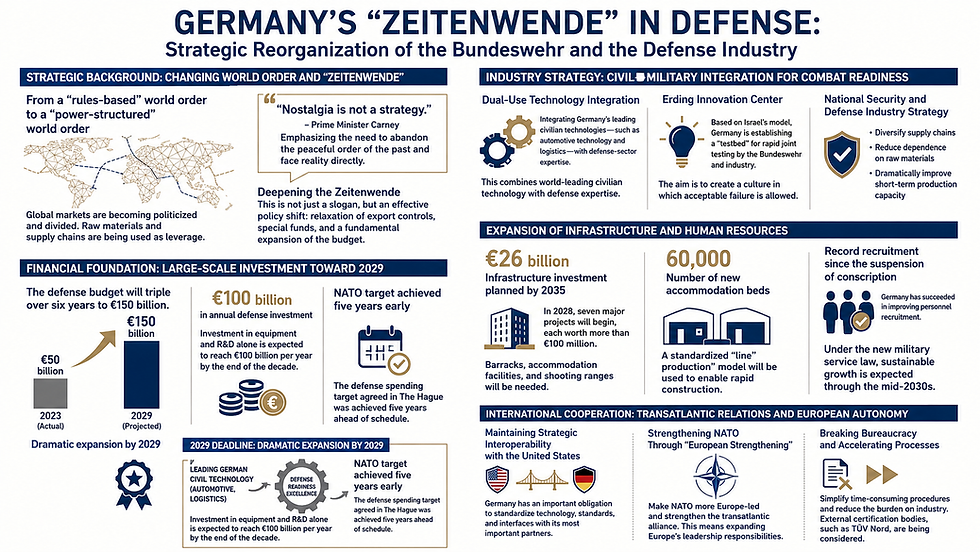
At the Hannover Messe, State Secretary Nils Hilmer delivered a transformative message on behalf of the Ministry of Defense: the renowned event is no longer merely an industrial showcase, but a foundational pillar of Germany's national security. Addressing distinguished guests, including Canadian Foreign Minister Mélanie Joly, Lower Saxony's Minister for Economic Affairs Olaf Lies (whom Hilmer addressed as "Minister-President Lies"), and various corporate leaders, Hilmer emphasized that global markets are now structured by power rather than rules, making supply chains and raw materials geopolitical levers. Quoting former Bank of Canada Governor Mark Carney (referred to by Hilmer as Canadian "Prime Minister Karne") at Davos, he stressed that "Nostalgia is not a strategy".
A Historic Financial Scale-Up
Following the Zeitenwende (historical turning point) decisively declared by former Chancellor Olaf Scholz, Germany is implementing an unprecedented expansion of its defense budget. Hilmer detailed several key financial milestones that underscore the rapid scale-up of the Bundeswehr (German Armed Forces):
The national defense budget will grow to €150 billion by 2029, effectively tripling within a six-year span.
In a single parliamentary budget committee session in December 2023, €50 billion was released explicitly for armament contracts.
By the end of the current decade, the defense ministry’s budget dedicated solely to arms investments will reach €100 billion.
Germany expects to hit the NATO target of spending 2% of its GDP on defense five years earlier than previously agreed upon in The Hague.
Fostering Civil-Military Innovation
Hilmer issued a pressing call to marry Germany’s world-leading civilian industrial capabilities—particularly in automation and supply chain optimization—with the established excellence of its defense sector. Emphasizing the need for agility, he introduced the military concept of Auftragstaktik (mission-type tactics) to procurement, a concept supported by the Inspector of the German Army, Major General Christian Freuding, who was present in the front row. Hilmer argued that the military must throw outdated, complex processes overboard and actively permit failure to foster innovation and learning.
The newly established Innovationszentrum (Innovation Center) in Erding serves as a joint testbed for the Bundeswehr and industry, drawing inspiration from Israel’s highly integrated civil-military security ecosystem.
The National Security and Defense Industry Strategy (SVI) mandates that the defense sector rapidly increase capacity, build supply chain resilience, and deliver practical innovations directly to the troops rather than just for showrooms.
Defense manufacturing has shifted from a niche market into a mainstream business opportunity, heavily encouraging the use of networking platforms like SVI Connect.
Expanding Infrastructure and Personnel
The military's growth extends far beyond purchasing ammunition and vehicles; it requires massive physical and personnel investments across the country:
The personnel expansion of the Bundeswehr requires the construction of 60,000 new beds.
Infrastructure order books for the military will total approximately €26 billion by 2035.
Seven major infrastructure projects, each valued at a minimum of €100 million, are slated to begin in 2026.
The "KAP Inland" (Kasernen-Aktionsprogramm Inland) program (recorded in speech transcripts as "GCAP Inland") enables standardized, "assembly-line" construction of military barracks in cooperation with federal states and the construction industry.
The Bundeswehr recently achieved its highest recruitment numbers since the suspension of mandatory conscription, laying the groundwork for continuous growth through the 2030s.
Strengthening Alliances and Slashing Bureaucracy
On the international stage, Hilmer reaffirmed that the United States remains Germany's most critical strategic partner. However, he asserted that "NATO must become more European for the alliance to remain transatlantic," highlighting General Breuer's candidacy for the chairmanship of the NATO Military Committee. Furthermore, interoperability with American systems remains an indispensable requirement for the German industry to strengthen the alliance.
To achieve these ambitious goals, Hilmer and industry leaders agreed that time-consuming European and domestic bureaucratic bottlenecks must be severely reduced. During the event's concluding moments, the moderator proposed utilizing established Hannover-based certification bodies, such as TÜV Nord and Dekra, to handle accreditations and relieve the Bundeswehr's procurement organization. Hilmer enthusiastically supported this practical solution, noting that dialogue with the head of TÜV is already actively underway.
Hilmer concluded by praising the defense industry's proactive steps, specifically highlighting Rheinmetall’s recent investments in a new plant located in the Lüneburg Heath, urging "more of that" from the sector. Following these remarks, the moderator formally introduced the next speaker: Armin Papperger, CEO of Rheinmetall AG, marking a transition from government strategy to industrial execution.


