

Global AI Playbooks: US Ecosystems vs. China’s AI Frontiers
- Miki Sadinov
- Jul 14
- 6 min read
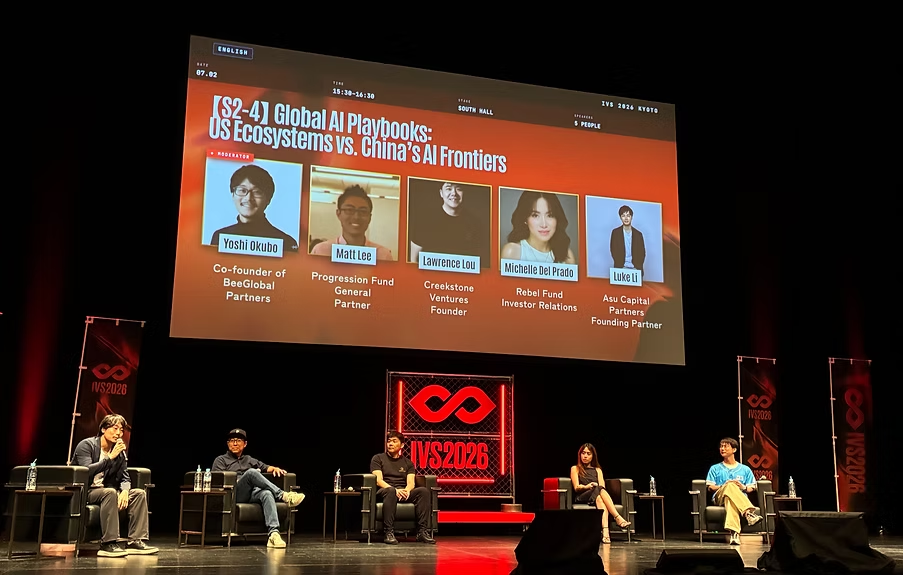
Inside the IVS2026 panel on valuation realities, rapid iteration, and the rise of service-driven AI delivery.
The global artificial intelligence landscape is evolving along deeply regional lines. At the IVS2026 conference, a panel of cross-border investors gathered to dissect how market dynamics, capital allocation, and user adoption are diverging across the world's major technology hubs.
The panel brought together:
Yoshi Okubo of BEENEXT, a Singapore-based venture firm managing US and India-focused portfolios.
Lawrence Lou, an early-stage AI investor associated with Cornerstone VC and a former product leader at Airbnb and Microsoft.
Michelle Del Prado of Rebel Fund, an early-stage venture fund built by the TikTok and Musical.ly alumni community.
Luke Li, co-founder of Tokyo-based Asu Capital Partners, a seed-stage investor pursuing a "Japan to Global" strategy backed by major listed companies like DeNA and MIXI.
Yansheng Li, partner of an emerging China-focused AI venture firm investing heavily in application layers.
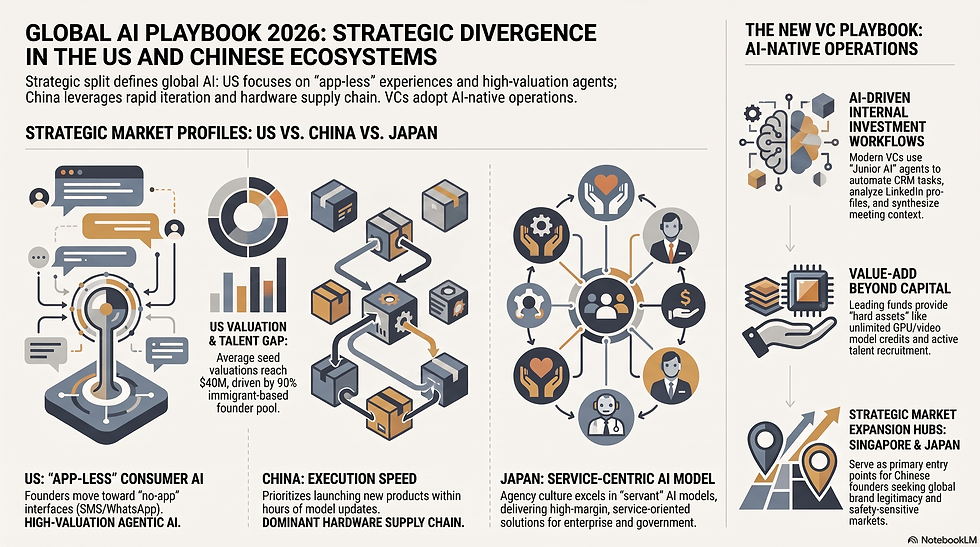
Together, they compared how capital, product development, and market adoption are evolving across the US, China, and Japan. The resulting discussion revealed a stark contrast between the capital-rich, hyper-competitive US market, the lightning-fast execution loops of China, and the unique, service-oriented business models carving out profitability in Japan.
Valuation Realities and the Outlier Mandate
The venture capital model is undergoing a structural shift driven by the unique economics of artificial intelligence. In the United States, capital remains highly concentrated, resulting in aggressive deal competition and elevated entry prices.
Key capital and valuation dynamics discussed during the session include:
US Valuation Premiums: According to figures cited during the panel, highly sought-after US AI startups can now command seed-stage valuations approaching or exceeding $40 million. One panelist observed that YC companies often raise capital so rapidly that their rounds are already three to four times oversubscribed before they even reach Demo Day.
Japan's Premium Shift: In contrast, the Japanese startup ecosystem has historically started at much smaller valuation scales. However, panelists noted that this gap is beginning to close at the top end of the market. While typical early-stage rounds remain modest, a small number of experienced serial founders in Japan are beginning to command seed valuations far above Japan’s historical norms, bridging the valuation gap with their global peers.
The Outlier Strategy: This shifting environment is forcing investors to redefine how they calculate risk and return. Traditional venture playbooks—where a fund targets a steady 5x or 10x return across a broad portfolio of companies valued at $5 million to $10 million—are becoming less viable in the AI era. Because large incumbent technology companies can quickly build or absorb basic AI features, early-stage startups face immense pressure to achieve scale rapidly. As a result, panelists explained that VCs are placing a much greater emphasis on identifying exceptional outlier teams capable of returning an entire fund—seeking massive, asymmetric outcomes rather than moderate, incremental successes.
Beyond the App: New Interfaces for Consumer AI
In the US consumer market, investors are observing a major shift in how AI-native products interact with users. Rather than forcing users to download and register on a standalone mobile app, developers are leveraging existing communication rails.
Panelists highlighted several emerging trends in consumer AI:
The Three-Year Window: One panelist observed that the next three years represent a critical window for founders to discover and build "killer" use cases in consumer AI that go beyond simple chat interfaces.
Zero-App Experiences: There is an increasing trend where developers build products without dedicated apps. Instead, the AI interacts with the user via a phone number, text messages, WhatsApp, or Slack. This interface shift makes interacting with an AI feel as natural as messaging or calling a friend.
The Power of Cross-Border Teams: Diverse founding teams often show unique competitive advantages. For example, some highly successful startups combine highly disciplined, hard-working technical talent from China with experienced US product and sales executives. This blend of rapid engineering execution and localized go-to-market expertise creates an exceptionally strong founding formula.
Rapid Iteration and China's Product Speed
While US startups focus heavily on foundational models and proprietary tech stacks, Chinese AI companies are distinguishing themselves through raw operational speed and practical application.
The panelists detailed the core advantages driving Chinese AI teams:
Ultra-Fast Product Launches: Panelists described Chinese product teams as moving exceptionally quickly—sometimes releasing initial applications within hours or days of a new model becoming available.
Strong Mobile Heritage: China's product managers bring a highly sophisticated growth and management style refined during the mobile internet era, allowing them to optimize application experiences at an unmatched pace.
Supply Chain Synergy: The country’s robust hardware and physical product supply chains make it much easier to deploy and scale AI-integrated hardware and "physical AI" applications.
Global-First Focus: Many emerging Chinese AI founders target the US and European markets from day one, leveraging their speed to capture international market share.
The Rise of Service-Driven AI Delivery in Japan
Japan represents a highly distinct market where startups are taking a very different route to commercialization. Rather than building pure software-as-a-service (SaaS) platforms, successful local players are leaning into Japan’s business culture.
Key elements of this Japanese AI playbook include:
Services-Led, Customization-Heavy Delivery: The most successful local AI startups are acting as high-touch implementation and transformation partners. Rather than selling raw software, they deliver fully customized AI services on behalf of large enterprises and government entities.
Immediate Revenue Generation: While Western audiences might favor pure software, this service-heavy approach is generating significant and immediate cash flow. Japanese AI companies are successfully monetizing these consulting and agency models, prioritizing profitability and client satisfaction over pure software scalability.
Distribution Barriers: Breaking into the Japanese corporate market is notoriously difficult. Capturing the first 50,000 to 100,000 users can happen quickly, but scaling beyond one million users typically requires a highly localized, enterprise-sales-driven approach. Consequently, many international startups choose to enter the market by partnering with local entities.
Model Evolution and the Open-Weight Advantage
A major point of discussion among the panelists was the ongoing competition between proprietary frontier models and open-weight models.
The Frontier Lead: While organizations like Anthropic maintain an estimated six-month technological lead at any given time, open-weight models are rapidly closing the gap.
Elevating the Class Standard: One panelist compared picking a frontier model to choosing the smartest student in the class. However, they argued that building a robust ecosystem is not about the top performer, but about raising the average standard of the entire class. Open-weight models perform this role by giving everyone access to advanced capabilities.
Traditional Industry Capture: In real-world sectors like manufacturing, logistics, and retail, proprietary frontier models may not be necessary. Instead, businesses can capture massive value by fine-tuning open-weight models for highly specific, vertical use cases, often achieving better unit economics and data privacy.
How Venture Firms Are Applying AI Internally
Venture capital is historically a highly human-centric, relationship-driven industry, but modern VCs are actively "dogfooding" AI to automate their operations and scale their investment teams.
The firms represented on the panel shared how they are integrating AI into their daily workflows:
Automated First-Round Interaction: Some emerging funds utilize custom web agents trained on the firm’s historical investments and investment thesis. These agents handle the entire first-round screening and response process for founders submitting pitch decks, answering questions with up to 80% accuracy.
Continuous Workflow Contextualization: Firms are using unified agentic systems, such as "Junior AI" assistants, to capture the full context of conversations, Slack messages, emails, and investment documents. These agents analyze the combined data to suggest action items, draft follow-up emails, and provide investment recommendations.
Seamless CRM Integration: Rather than manually logging data, partners utilize AI transcription and summarization tools that automatically extract key action items from founder meetings, log them directly into the CRM, and assign tasks to the appropriate team members.
Scaling Human Capital: These AI layers allow venture firms to remain lean. For example, funds can manage extensive data scraping and outbound campaigns with very small data teams, utilizing AI to handle the highly repetitive work while human investors focus on building relationships and evaluating founders.
Global Capital Dynamics and Outlook
The geopolitical and macroeconomic climate has introduced significant headwinds for US-dollar-denominated venture funds in China, with many mega-funds shrinking by half in recent years. However, panelists noted that the tide is beginning to turn.
LPs Returning to China: Large institutional investors and limited partners are starting to return to China, driven by a desire to study China’s rapid progress in the AI application layer and physical AI.
Accessing Global Pools: In regions like Southeast Asia, local family offices and smaller institutional investors often struggle to gain direct access to top-tier US AI opportunities. Emerging, cross-border venture managers are increasingly serving as vital bridges, connecting international capital to US and Chinese technology frontiers.
Ultimately, the IVS2026 panel demonstrated that there is no single "correct" playbook for building or investing in artificial intelligence. Success is defined by how well founders and investors adapt to the distinct capital environments, development speeds, and cultural expectations of the markets they choose to serve.


