

Humanoid Robots: The Next Engine of Industrial Growth
- Miki Sadinov
- Jun 11
- 5 min read
Session Name: Humanoid Robotics: The Next Engine of Industrial Growth
Speaker:
Sven Krause — Moderator
Prof. Dr.-Ing. Alexander Schönmann — Professor, Industrial Engineering, Technische Hochschule Ingolstadt
Andreas Zeug — Project Manager, Humanoid Robotics, Schaeffler Technologies AG & Co. KG
Sven Parusel — Head of Research Partnerships, Agile Robots SE
Session Summary:
This panel explores humanoid robotics as Europe's next critical industrial growth engine, analyzing real-world factory deployments and the distinct complexities of training physical AI. The experts emphasize the urgent need to close the maturity gap between rapidly advancing hardware capabilities and lagging safety ecosystems. Furthermore, they highlight how workforce acceptance, strict data privacy, and the race to establish a scalable dominant design will ultimately dictate the industry's success.

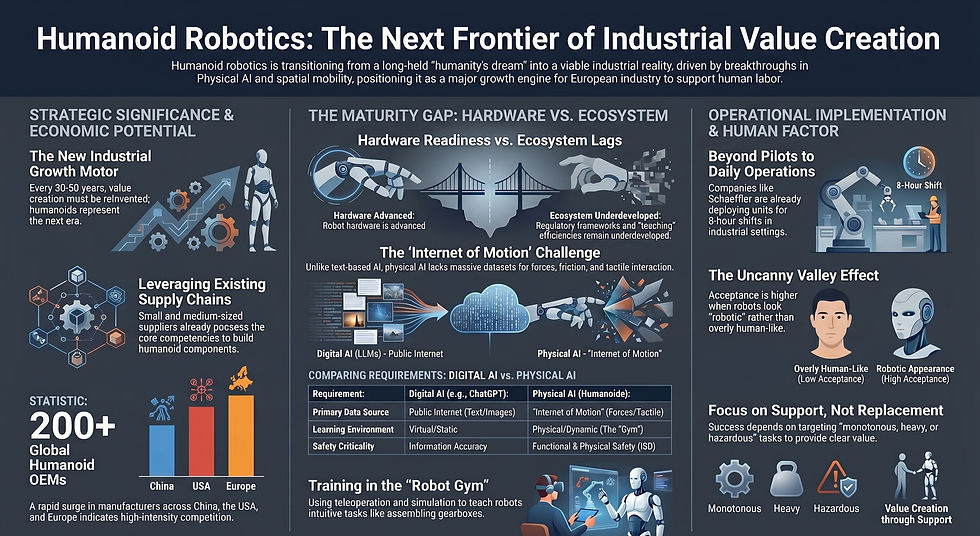
Humanoid Robots: The Next Engine of Industrial Growth
Humanoid robotics is no longer just a fleeting technology trend; it is the culmination of a 150-year-old human dream. As highlighted in a recent panel moderated by Sven Krause at Hannover Messe, this current wave of development is closer to reality than ever before. Prof. Dr.-Ing. Alexander Schönmann of Technische Hochschule Ingolstadt argues that humanoid robotics, driven by the modern convergence of artificial intelligence and spatial mobility, has the potential to become the next massive economic growth engine. This is particularly critical for regions like Germany and Europe that must reinvent their value creation every 30 to 50 years to supplement traditional industries like automotive manufacturing.
Beyond the Hype: Factory Realities vs. Trade Show Dances
While social media and trade fairs often showcase robots dancing or performing full-body movements, the true measure of their progress lies in practical industrial application. At Schaeffler Technologies AG & Co. KG, humanoid robots have already moved well beyond the pilot phase. Andreas Zeug, Project Manager for Humanoid Robotics at Schaeffler, confirmed that the company currently operates three bipedal units from Agility Robotics that work full eight-hour shifts daily at a production facility in the United States.
This real-world deployment provides an extreme learning curve for developers and manufacturers. Because factory floors are unpredictable—often transitioning from concrete to slippery, oil-slicked steel plates—robots must make micro-adjustments to remain upright. A robot losing its balance and falling is considered the ultimate worst-case scenario in production. By observing Agility Robotics' units in action, Schaeffler feeds data regarding joint stress, forces, and dynamics directly back into the development of their own highly precise actuators, which provide the vital hardware foundation for the robots' physical stability.
Bridging the Gap: Hardware vs. Ecosystem
Despite immense venture capital flowing into the approximately 200 global humanoid manufacturers, experts warn against prematurely declaring these systems ready for mass production. Sven Parusel, Head of Research Partnerships at Agile Robots SE, notes that while his company also showcases dancing humanoids at their booth, the industry must view the current hype cycle critically. To accurately assess the maturity of humanoid robots, Prof. Dr.-Ing. Schönmann emphasizes the need to differentiate between two crucial areas:
Hardware Maturity: Full-body movements, such as walking and balancing, are seeing rapid acceleration and immense progress. However, Parusel points out that complex fine manipulation remains a significant technological hurdle; tasks requiring five-finger robotic hands to insert parts or perform delicate assemblies are still highly difficult.
Ecosystem Maturity: The surrounding infrastructure is lagging far behind the hardware capabilities. There is a massive gap in ecosystem maturity, which includes establishing regulatory frameworks, defining functional safety standards, and creating efficient interfaces to quickly teach the robots new tasks.
The "Internet of Motion" and AI Training
While text-based AI models like ChatGPT had the benefit of an existing internet filled with human knowledge, there is currently no "Internet of Motion" to train physical AI. To navigate the real world, a physical AI must understand complex physical variables like gravity, friction, multi-dimensional forces, and tactile feedback. To generate this vital industrial dataset, companies are utilizing innovative training approaches:
The "Gym": Engineers use secure innovation spaces called "Gyms" to replicate real production workflows and safely train robotic models without risking live factory floors.
Capturing Human Intuition: Operators use virtual reality headsets and remote controls to physically guide robotic arms through tasks. This captures not just the path of movement, but the intuitive human "feeling" and strategic decision-making required for tight-fitting assemblies, such as smoothly mounting a tightly-toleranced gear onto a bolt.
The Human Factor: Acceptance and Data Privacy
For any new technology to be accepted by the workforce, it must offer a direct added value and be easy to use—the exact two factors that drove ChatGPT's explosive growth. Currently, Prof. Dr.-Ing. Schönmann notes that humanoids fail the "ease of use" test. In laboratory settings, a single faulty line of code can cause an 80kg machine to collapse and thrash unpredictably, creating immediate fear and building a barrier to worker acceptance.
However, when deployed strategically on the factory floor, acceptance is remarkably high. Zeug explains that at Schaeffler, workers have welcomed the robots with curiosity because they are explicitly designed to assist rather than replace humans. They are proactively assigned to:
Monotonous duties, like repeatedly lifting heavy boxes onto conveyor belts.
Hazardous operations, such as entering rooms filled with toxic 3D printer powder where human workers would otherwise require full protective suits.
Furthermore, the integration of humanoids raises significant data privacy concerns. Because these robots navigate using six to ten constantly recording cameras, companies must collaborate strictly with works councils to establish robust rules regarding data access. Zeug emphasizes that, just as corporate trust frameworks are established for platforms like Microsoft Teams, strict protocols must be enacted immediately to protect employee privacy and corporate trade secrets.
Global Competition and the Dominant Design
As the United States pours massive venture capital into AI and China rapidly accelerates its hardware manufacturing, Europe remains highly competitive. Parusel believes Europe can leverage its traditional strength in "German Engineering". The ability to take raw technology and reliably integrate it into highly complex, value-creating factory automation systems gives the European market a distinct industrial edge.
Ultimately, Prof. Dr.-Ing. Schönmann argues that the winner of the humanoid race will not necessarily be the first company to manufacture 10,000 units, but rather the one that establishes the "Dominant Design". Much like Apple did with the smartphone ecosystem via the App Store and iTunes, the dominant design for robots will set the global standard for hardware form factors, multi-layered safety frameworks, and teaching interfaces, enabling true economic scalability.
Looking Ahead: Overcoming the Uncanny Valley
As the industry looks toward serial production, the focus must shift to redefining use cases that complement human abilities, rather than forcing robots to perfectly mimic human form. Interestingly, while early robots featured abstract designs to avoid the "Uncanny Valley"—the psychological revulsion humans feel when a machine looks almost perfectly human—newer models are taking a different approach. Prof. Dr.-Ing. Schönmann specifically highlighted the Unitree H2 at the trade fair, noting its surprising incorporation of a more realistic human face, which marks an unexpected shift in robotic design.
While fully autonomous, general-purpose household robots reminiscent of science fiction remain far in the future due to the highly unstructured nature of domestic environments, structured industrial factory floors are already witnessing the dawn of the humanoid workforce.


