

Japan’s New Startup-Finance Standard: Closing the Post-IPO Growth Gap
- Miki Sadinov
- Jul 19
- 6 min read
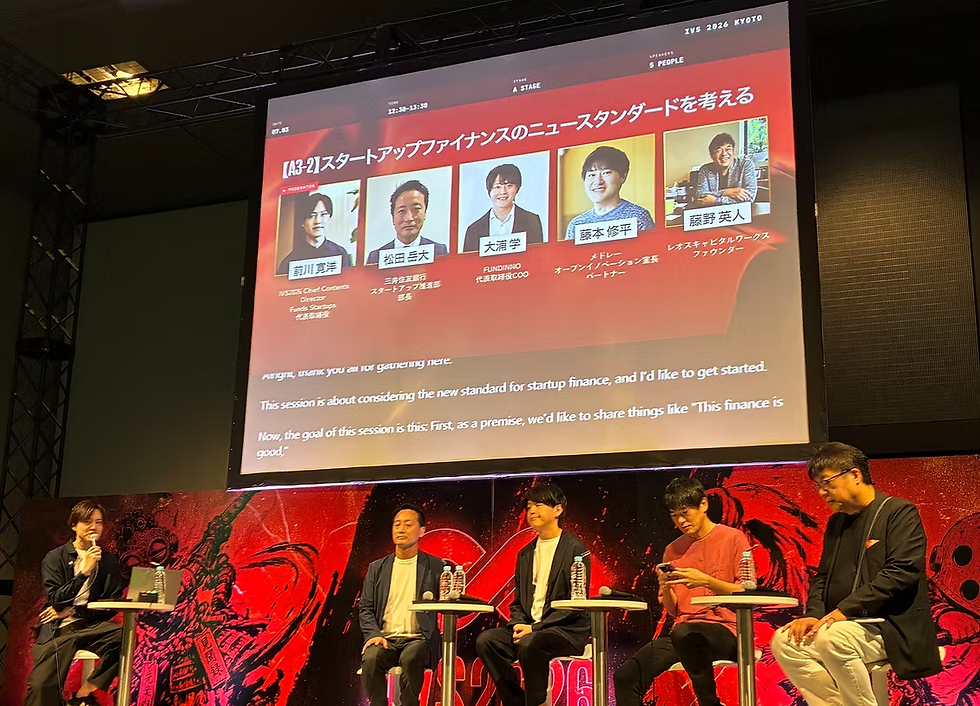
Japan’s startup-finance market is broadening beyond traditional venture equity, but significant gaps remain between late-stage private funding, IPOs, and sustained growth as a listed company. At the IVS2026 panel, "Rethinking the New Standard of Startup Finance," industry pioneers representing commercial banking, private placements, corporate investment, and public asset management convened to dissect the structural issues hindering Japan's startup ecosystem and map out a more integrated financial lifecycle.
The session, moderated by Hirohiro Maekawa (Chief Contents Director of IVS2026 and Representative Director of Funds Startups), featured Takehiro Matsuda (General Manager of the Startup Promotion Department at Sumitomo Mitsui Banking Corporation), Manabu Oura (Representative Director and COO of FUNDINNO, Inc.), Shuhei Fujimoto (Partner at the Open Innovation Office of Medley, Inc.), and Hideto Fujino (Founder, Chairman, President, and CEO of Rheos Capital Works Inc.). Together, they debated how startups can navigate the current macroeconomic winter by blending debt, corporate partnerships, and private secondary markets.
The Pre- and Post-IPO Policy Divide
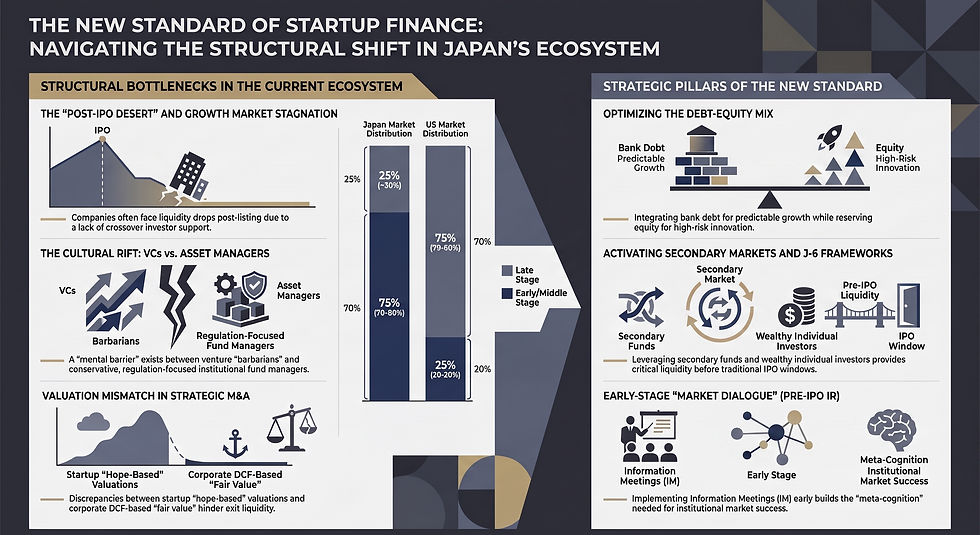
A central bottleneck in Japan's startup lifecycle is the dramatic cultural and regulatory transition a company undergoes upon listing. Hideto Fujino, Chairman, President, and CEO of Rheos Capital Works Inc., noted that this difficult transition often feels like crossing a desert only to find another endless desert on the other side.
Fujino highlighted a rhetorical but instructive institutional contrast:
Pre-IPO: Startups are incubated under the growth-oriented policies of the Ministry of Economy, Trade and Industry (METI), which focuses heavily on industrial promotion and expansion.
Post-IPO: Listed companies fall under the oversight of the Financial Services Agency (FSA), where the primary mandate is investor protection, transparency, and market safety, rather than active business growth.
While listed-company oversight involves a complex network of institutions—including the Tokyo Stock Exchange (TSE), Japan Exchange Group (JPX), independent auditors, and the Securities and Exchange Surveillance Commission (SESC)—the philosophical shift remains stark.
This transition is compounded by a structural funding mismatch. Fujino observed that while late-stage funding represents an estimated 70% to 80% of venture capital allocation in the United States, it accounts for only about 30% in Japan, leaving Japanese startups undercapitalized as they approach public markets.
Consequently, newly listed small-cap startups often face a severe post-listing "growth freeze." Navigating rigid budget-to-actual variance management (yojitsu-kanri) and intense public market pressure to meet disclosed forecasts, companies routinely pause higher-risk growth initiatives or aggressive capital raises for approximately two years to establish predictable earnings. During this same window, pre-IPO venture capital funds, driven by fiduciary duties to return capital to their limited partners (LPs), create a structural supply overhang as lock-up periods expire, putting further downward pressure on share prices.
Fostering Alignment Between VCs and Public Asset Managers
To bridge this chasm, the panel emphasized the need to break down the deep-seated cultural barriers between private venture capitalists and public equity managers. Fujino illustrated the mutual stereotypes that exist today:
Venture capitalists often view public market fund managers as a "group of salarymen" overly constrained by rigid compliance, risk parameters, and institutional processes.
Conversely, public asset managers frequently caricature venture capital investors as undisciplined "barbarians" or "savages" who invest without a fundamental grasp of accounting standards or rigorous valuation metrics.
To build a seamless capital ecosystem, both communities must recognize that they are part of a shared capital lifecycle. Fujino argued that the path forward lies in active cross-pollination. Rather than relying solely on policy changes, the startup community should actively invite public mutual fund managers, institutional buy-side analysts, and public equity specialists to private-market forums like IVS. Fostering these early relationships demystifies the public market's expectations for founders long before they list.
Bank Debt and Credit Assessment: The SMBC Playbook
As equity markets tighten, venture debt has become a more established financing option for Japanese startups. Takehiro Matsuda, General Manager of the Startup Promotion Department at Sumitomo Mitsui Banking Corporation (SMBC), provided practical insight into bank credit assessment, clarifying how financial institutions evaluate high-growth, pre-revenue businesses.
Rather than relying purely on automated scoring or rigid algorithms, bank credit departments apply manual downside adjustments and rigorous stress-testing scenarios to evaluate a startup’s minimum repayment capacity under worst-case conditions.
Based on this reality, Matsuda explained a crucial strategic concept regarding the "stretch plan":
Founders should not submit artificially conservative or "safe" business plans to banks.
Because credit departments automatically apply conservative haircuts and downward stress scenarios to any proposal they receive, starting with an overly conservative plan may cause the stress-tested version to appear unviable.
Instead, founders should present their genuine, ambitious growth strategy ("stretch plan") supported by clear, logical operational assumptions.
Matsuda also emphasized proper asset-liability matching. Highly uncertain, early-stage R&D is generally better suited to risk-bearing equity capital. Debt, conversely, is most appropriate for predictable expenditures—such as expanding a proven product line or bridging working capital—supported by visible, near-term repayment capacity.
Medley's Philosophy: M&A, Down Rounds, and Corporate Partnerships
For mature startups, corporate partnerships and M&A represent vital alternatives to public listings. However, Shuhei Fujimoto, Partner at the Open Innovation Office of Medley, Inc.—a publicly listed healthcare-technology company operating employment and medical DX platforms—cautioned against one-sided partnership proposals.
Fujimoto noted that startups often pitch partnerships that benefit only their own valuation, ignoring the corporate partner's commercial logic. To secure strategic corporate investment, startups must align their proposals with the corporate's core business requirements, demonstrating how the partnership will drive concrete revenue generation or highly defined operational efficiencies.
When evaluating strategic investments, Fujimoto explained that Medley, Inc. maintains a highly disciplined approach to valuation. Rather than compromising during market bubbles or relying on heavy, theoretical Discounted Cash Flow (DCF) calculations that can obscure practical business dynamics, Medley evaluates targets based on realistic, market-supported strategic upside. Fujimoto noted that the company is entirely comfortable proposing down rounds if the prevailing private market valuation does not align with actual commercial fundamentals.
A Theoretical Model: "Corporate Venture Debt"
During the panel, a novel, theoretical financing model emerged: corporate venture debt. Under this conceptual framework, corporate strategic partners could purchase milestone-linked bonds issued by a startup.
Repayment terms, interest rate adjustments, or covenant relief would be dynamically tied to the startup achieving specific commercial or operational milestones in the partnership (e.g., successful technology integration or revenue targets).
While highly attractive, the panel noted that such structured instruments currently face significant legal, tax, and money-lending regulatory hurdles before they can become standard market products.
Private Markets and the J-Ships Framework
Building robust private market liquidity before an IPO is essential to prevent premature listings. Manabu Oura, Representative Director and COO of FUNDINNO, Inc., detailed how Japan's regulatory tools can support this objective.
Oura clarified the distinction between primary capital raises and secondary liquidity:
The J-Ships Framework: J-Ships (Japan's system for offering unlisted securities to professional investors) is primarily a mechanism for primary private placements. It allows startups to solicit capital from professional investors, including eligible high-net-worth individuals, without traditional solicitation-number limitations.
Secondary Liquidity: To buy out early venture capital investors or founders, distinct secondary mechanisms—such as shareholder communities or specialized platforms like FUNDINNO MARKET—must be utilized.
Oura explained that through specialized services like FUNDINNO PLUS+, individual professional transactions can be structured up to ¥10 million, with target primary fundraising rounds reaching up to ¥1 billion. He clarified that these figures represent FUNDINNO's specific platform service levels rather than legal statutory caps of the broader J-Ships framework, which legally accommodates much larger transactions for eligible issuers.
Valuing the Company Through the Market’s Eyes
To succeed across this shifting landscape, startups must cultivate objective market intuition. Oura and Fujino recommended that companies begin conducting Information Meetings (IMs) with public market institutional investors early in their growth cycle, well before initiating the formal IPO process.
Fujino compared public-market analysts to "anatomists" who carefully dissect a company's financial health, testing every core assumption behind its growth narrative. Engaging with these professionals early helps founders build "meta-cognition" —the ability to view their own business with cold, analytical detachment.
Fujino offered a powerful consumer analogy:
Founders are naturally subjective and emotional about their company's stock.
However, they must learn to treat their shares as a competing investment product sitting on a supermarket shelf.
Just as a consumer compares products on price, quality, and utility, public investors evaluate equity relative to all other listed alternatives. Cultivating this objective perspective is essential for realistic pricing and long-term market trust.
Navigating the Godzilla and Minilla Cycles
Concluding the session, Fujino shared his "Godzilla and Minilla" macro framework, representing the natural, alternating market regimes of the financial system:
The Godzilla Cycle: A market dominated by large-cap, value-oriented stocks.
The Minilla Cycle: A market highly supportive of small-cap, high-growth companies.
Fujino observed that in mid-2026, the global economy remains in a dominant Godzilla cycle, driven by high interest rates and large-cap outperformance. Under these conditions, small-cap growth companies naturally struggle to attract capital.
Crucially, Fujino warned that domestic policy interventions, such as government startup promotion councils, can do very little to alter these deep, global macroeconomic currents. The transition between cycles is highly unpredictable, taking anywhere from "three days to three years."
Therefore, the ultimate consensus of the panel was clear: startups navigating the current environment must avoid relying on sudden market rescues. Instead, they must proactively preserve runway, maintain financing flexibility by combining debt and strategic corporate partnerships, and continue strengthening their underlying business fundamentals until global market conditions once again become supportive of small-cap growth.


