

Revolutionizing the Global Materials Industry with Mushroom Mycelium: The Challenge of MYCL, a Biotech Startup from the National University of Singapore
- 安田 和貴/Yasuda Kazuki

- Jul 8
- 5 min read

Across the apparel and manufacturing industries, the shift toward sustainable materials with lower environmental impact has become an urgent global priority. In particular, the leather market presents a massive business opportunity for biosynthetic leather and other bio-based materials. However, many existing alternatives still rely on plastic-based materials such as polyurethane (PU) and polyvinyl chloride (PVC).
One company attracting attention as a fundamental solution to this social challenge is MYCL, also known as Mycotech Lab, a biotech company based in Indonesia and Singapore. MYCL develops environmentally friendly, high-performance next-generation materials by utilizing previously unused agricultural waste, mushroom mycelium, and algae.
In this article, we spoke with Ronaldiaz Hartantyo, Co-Founder of MYCL, who has a background in architecture and is leading the company’s innovative materials development under the belief that “mushrooms can save the world.” We asked him about MYCL’s technological advantages, real-world use cases, and ambitious plans for future business expansion.
A Unique Approach to Creating High-Performance Materials from Agricultural Waste
Our mission is to produce sustainable materials using mushroom mycelium and algae, including seaweed. At present, we are mainly focused on developing three types of materials: Mylea, a leather-like material made from mycelium; composite materials for structural and architectural applications, in which mycelium functions as a natural adhesive; and Mylea Sea, an algae-based material.
I personally have been using products made with Mylea, such as a laptop case, bags, and watch straps, for more than five years, and I experience their high durability in my daily life.

The core of our technology lies in the process of transforming unused agricultural waste into high-performance mycelium leather through the power of mycelium. Launched in 2015, our founding and research team brings over 15 years of combined expertise in biomaterials research and development.
We also work with local farmers and communities around Leuser National Park in Indonesia. By utilizing their agricultural waste, we provide them with new sources of income while also contributing to nature conservation. In this way, we are building a circular ecosystem.

Strong Cost Advantages and Partnerships in the Global Market
There are competitors in Europe and the United States that have raised tens of millions to hundreds of millions of US dollars, but some of them have already shut down their businesses. By contrast, although we have raised a relatively modest amount of approximately USD 2.2 million since 2018, we have established a solid position as a frontrunner in Asia.
Our greatest strengths are affordability and scalability. Through thorough process optimization, we have significantly reduced our manufacturing cost from 79% of the selling price to 39%, and we have already achieved profitability on a gross margin basis. In terms of quality, with support from organizations such as the World Bank, we have obtained OEKO-TEX certification, which is regarded as one of the highest standards for sustainable materials.
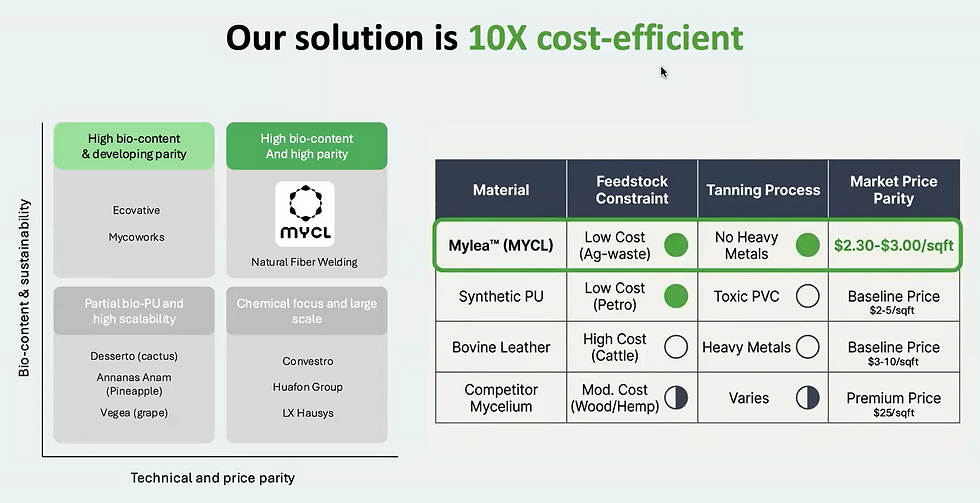
To date, we have supplied our materials to more than 800 customers, and our Net Dollar Retention exceeds 100%, reflecting very strong repeat demand. We have signed an MOU with Vivobarefoot, a UK-based footwear company, and plan to launch pilot shoes on a scale of tens of thousands of pairs next year or in 2028. We are also jointly developing prototypes with adidas.

Use Cases in the Japanese Market and Future Business Development
In the Japanese market as well, numerous collaborations with highly design-conscious brands and companies are already underway.
Adoption in fashion and apparel: The Japanese brand doublet has been using our materials extensively since Paris Fashion Week in 2021, applying them to leather jackets, winter coats, footwear, bags, and other accessories. We are also steadily advancing collaborations with footwear brands such as Hijack Sandals, launched in Tokyo, domestic brands such as FUMIKODA, and local artisans.
Other Custom projects in Japan: We are also working on a number of unique custom projects, including the “Mushroom Hotel” in Komoro City, Nagano Prefecture, and the development of a “mycelium chair for the lunar surface,” which is planned for next year.
As part of our future expansion, we will hold a pop-up event in collaboration with Urban Research at NEWoMan Takanawa Gateway this July, marking the start of full-scale retail development in Japan. We are also partnering with the apparel brand Highmount and plan to showcase our algae-based material at an event in Ikebukuro in September. In the future, we hope to further deepen partnerships with companies such as BEAMS, SHIPS, and Dover Street Market.

Expanding Beyond Fashion and Taking on the Challenge of Scaling Up
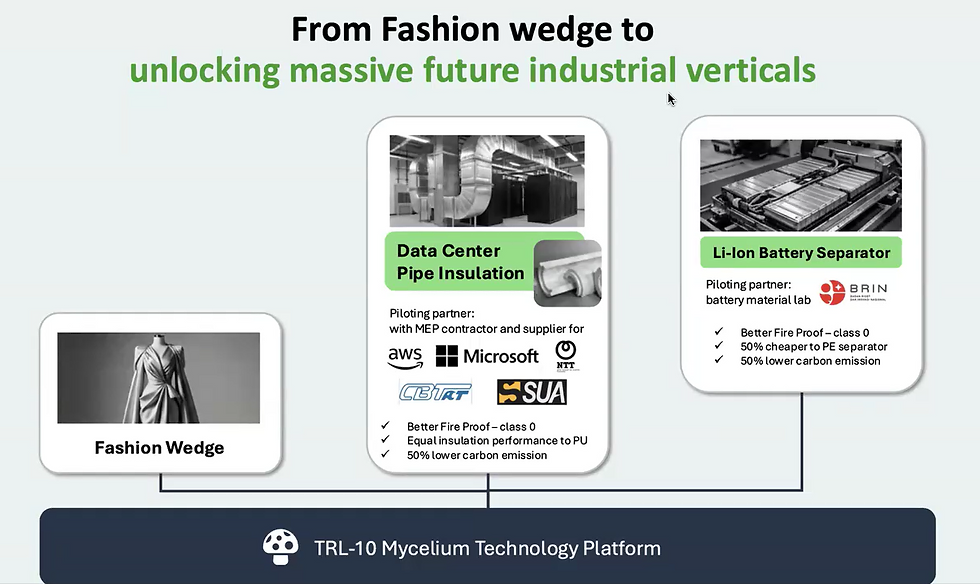
We are currently exploring applications of our technology beyond the fashion industry. In particular, we see strong potential in insulation materials for data centers and battery separators. As demand for data centers rapidly increases around the world, there is a growing need for sustainable thermal insulation materials that can replace conventional PU. In demonstration tests in Indonesia, we have already obtained very positive results.
We have also received interest from the automotive industry. However, this sector requires both high quality and low cost, making economies of scale essential.
The biggest challenge we currently face is limited production capacity. Vivobarefoot has requested production equivalent to up to 100,000 square feet, or 50,000 pairs of shoes, while adidas has requested a minimum of 1.5 million square feet per collection. However, our current production capacity remains at only 10,000 square feet, and we are not yet able to fully meet demand.
For this reason, we are currently aiming to raise at least USD 3 million in additional funding. With this capital, we plan to build a demonstration plant and introduce a semi-automated system, enabling a dramatic increase in production capacity and further cost reductions. In the future, we plan to work not only with farmers in Indonesia, but also with farmers around the world, decentralizing our production bases globally.
Conclusion
MYCL’s business is not limited to simply providing a new alternative material for the apparel industry. From returning value to local economies through the effective use of agricultural waste to cutting-edge industrial applications such as insulation materials for data centers, the social impact of MYCL’s mycelium technology is immeasurable.
In the highly competitive field of biomaterials, MYCL has built a solid business foundation by combining outstanding cost performance with sustainability. The company’s efforts are likely to play a powerful role in accelerating the transition toward a circular society. Expectations are high for MYCL’s next stage of growth as it moves toward establishing a global mass-production system.
Interviewed Company Overview
Company Name: MYCL / Mycotech Lab
Website: https://mycl.bio/
* For inquiries regarding collaboration or business discussions with the interviewee company, please contact either Third Ecosystem, inc., the operator of this media platform, or the interviewee company directly.


