

Next-Level Automation: How BMW is Pioneering Physical AI and Robotics in Global Production
- Miki Sadinov
- Jun 11
- 5 min read
Updated: Jun 25
Session: Next Level AI and Robotics in Production Speaker: Dr. Michael Nikolaides, Senior Vice President of Production Network, Logistics, and Supply Chain Management, BMW Group
Session Summary:
This session details the BMW Group's transition toward digitalized manufacturing, emphasizing that establishing a clean, cloud-based data architecture is the fundamental prerequisite for successfully deploying completely autonomous "Physical AI". Dr. Nikolaides showcases four advanced applications currently operating in BMW factories, including autonomous smart transport robots (STRs) and sophisticated robotic models like SpOTTO, Figure 02, and the wheeled humanoid AEON. To efficiently scale these technological breakthroughs across its global production network, BMW has launched a new AI Competence Center in Munich focused on mastering the necessary "Integration Competence".

Next-Level Automation: How BMW is Pioneering Physical AI and Robotics in Global Production
The automotive industry is standing on the precipice of a new industrial revolution, shifting away from evolutionary progress toward exponential paradigm shifts. At the forefront of this transformation is the BMW Group. According to Dr. Michael Nikolaides, Senior Vice President of Production Network, Logistics, and Supply Chain Management at BMW, the company's future viability relies heavily on the profound digitalization of its global production processes. From software-based, artificially intelligent planning algorithms to the deployment of advanced humanoid robots, BMW's manufacturing ecosystem is undergoing a dramatic evolution.
The Strategic Foundation: iFACTORY and Data Restructuring
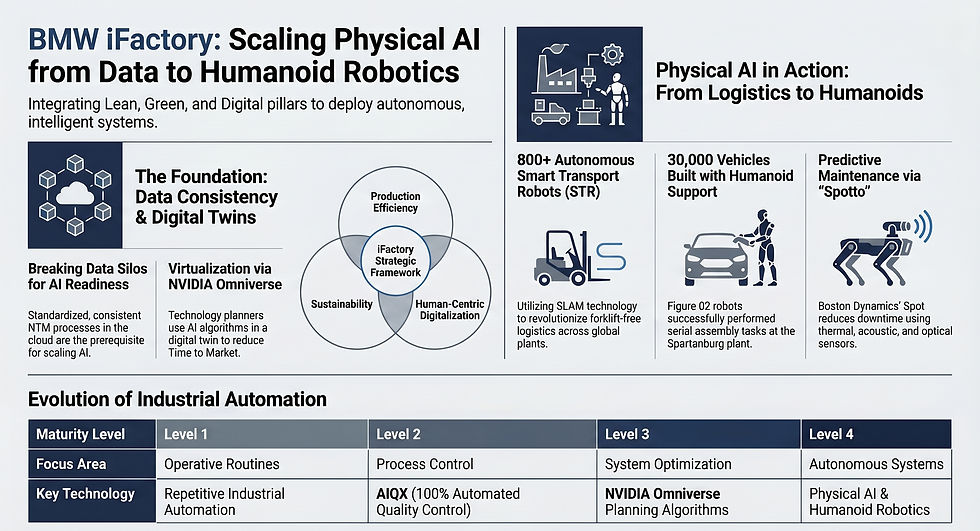
The overarching framework guiding this digital transformation is BMW's "iFACTORY" strategy. This approach merges the traditional manufacturing virtues of "Lean" (production efficiency) and "Green" (sustainability) with modern digitalization, the skills of the human workforce, and artificial intelligence. Artificial intelligence is no longer viewed as a supplementary add-on; rather, AI in both its virtual and physical forms serves as a core crystallization point for the company's operational strategy.
However, before organizations can successfully leverage highly publicized AI capabilities, a crucial foundational step must be taken. Dr. Nikolaides emphasizes that true AI integration requires a complete restructuring of underlying data architectures. Historically, manufacturing facilities relied on isolated machines operating as "data silos" with information stored on standalone servers, making comprehensive cross-system analysis virtually impossible. To solve this, BMW invested immense resources into renovating its data structures. Today, the company's data is consistent, highly standardized across its global production and technology processes, and universally available via the cloud—an absolute prerequisite for scaling AI applications.
The Four Stages of Digital and Physical Integration
With a pristine data foundation established, BMW conceptualizes the integration of the physical world and automation across four distinct evolutionary stages:
Operative and Repetitive Routines: The initial phase focused on classic industrialization and the automation of manual, repetitive tasks, which required little to no artificial intelligence.
Process Control and Steering: The second stage introduced AI to actively manage and govern processes. A prime example is BMW's internal "AIQX" system, which utilizes AI algorithms to autonomously make decisions and fully automate quality control processes to 100%.
Analysis, Planning, and Optimization of Entire Systems: Moving beyond individual processes, BMW partnered with Nvidia to transfer its entire physical production system into the virtual "Omniverse". By leveraging AI algorithms in a virtual space, technology planners can conceptualize new products much earlier, significantly reducing time-to-market and lowering initial industrialization expenditures.
Entity AI and Completely Autonomous Systems: The current and most advanced stage involves "Physical AI". This leap is driven by the convergence of cleaned data, internal and external domain expertise, and exponential advancements in Large Language Models (LLMs). The result is globally deployed production systems that operate with complete autonomy and intelligent automation.
A Historical Perspective on Automation
To contextualize the rise of Physical AI, it is highly useful to look back at the introduction of the first primitive industrial robotic arms in the 1970s. These early machines transformed car body manufacturing into a 100% industrialized operation, though they sparked debates regarding safety and job security that closely mirror today's discussions about AI. History demonstrated that industrialization was the primary enabler of global growth, ultimately creating new, higher-qualified employment opportunities rather than permanently eliminating jobs.
However, those early robots were fundamentally "dumb" and deterministic; they executed programmed motions regardless of obstacles, necessitating large safety fences. While collaborative robots (cobots) introduced in 2013 possessed enough basic intelligence to stop upon physical resistance, they still lacked true cognitive intelligence—a limitation that Physical AI is finally overcoming.
Physical AI in Action: Four Groundbreaking Deployments
BMW's commitment to autonomous systems is not theoretical; it is actively visible across its global factory network through several highly advanced deployments:
Smart Transport Robots (STRs): Developed in-house and with partners, these flat, yellow robotic platforms have completely revolutionized factory logistics. Eliminating the need for traditional human-driven forklifts, STRs utilize SLAM (Simultaneous Localization and Mapping) technology to navigate spaces autonomously. They do not rely on pre-programmed routes; if an obstacle blocks their path, they independently recalculate and optimize their route, and even manage their own charging cycles. BMW currently operates over 800 of these intelligent systems worldwide.
SpOTTO (The Maintenance Watchdog): In the Hams Hall engine plant in the UK, BMW utilizes Boston Dynamics' robotic dog, affectionately named "SpOTTO," as an autonomous maintenance watchdog. Equipped with optical, acoustic, and thermal sensors, SpOTTO autonomously navigates complex factory environments, successfully identifying and climbing stairs without falling. Its deployment has drastically reduced maintenance costs and extended the operational time between equipment failures.
Figure 02 Humanoid Robot: Partnering with the American company Figure AI, BMW successfully tested the Figure 02 humanoid robot in the body shop of its Spartanburg plant in the USA. The robot performed complex insert tasks, seamlessly interacting with STRs that delivered parts. Figure 02 demonstrated remarkable cognitive intelligence by adapting to intentional environmental manipulations, continuously learning from day to day. Highlighting its real-world impact, this robot actively participated in the manufacturing of 30,000 BMW X3 vehicles.
AEON Humanoid Robot: Embracing a multi-partner strategy, BMW is collaborating with European partner Hexagon to pilot the "AEON" robot at its Leipzig factory in Germany. Following successful tests, AEON will enter live series-production in battery assembly and component manufacturing. Uniquely, AEON features a humanoid upper body but navigates on wheels—a design choice that provides distinct mobility advantages on flat factory floors, proving that the specific manufacturing use case dictates the necessary physical form of the robot.
Scaling the Future: The AI Competence Center
Ultimately, BMW defines "Physical AI" as the capability of machines to comprehensively understand their surrounding environment, accurately contextualize events, and make autonomous decisions. Recognizing the astonishing learning curves of these systems, the automaker plans to aggressively roll out these use cases across its global footprint, including facilities in the US, Germany, and China.
To centralize and accelerate this critical field, BMW recently established a new AI Competence Center in Munich, Germany. This center serves as a collaborative hub for internal specialists, research and development experts, and external industrial partners. According to Dr. Nikolaides, the ultimate success of AI in manufacturing hinges on "Integration Competence"—the complex ability to seamlessly align different specialized technological factions, maintain pristine data structures, and successfully scale pilot innovations into broad series-production applications. As young engineers and experts continue to push these boundaries, BMW is securing its position as a pioneer in the next generation of automated, intelligent manufacturing.


