

Tackling the 2040/2050 Infrastructure Crisis: Hitachi Projects a 100-Trillion-Yen "Physical AI" Market, Fueling Strategic Alliances with Microsoft and Anthropic
- Miki Sadinov
- Jul 8
- 5 min read
As developed nations face the unprecedented challenges of rapidly aging social infrastructure and severe labor shortages, Hitachi, Ltd. is positioning itself at the vanguard of the next industrial revolution. At Hitachi Physical AI Day, which drew registrations from over 2,000 customers, the company unveiled a bold roadmap to capture a projected market potential exceeding 100 trillion yen by fusing Physical AI with autonomous AI Agents.
In the opening address, Mr. Hosoya, who leads Hitachi’s digital business with AI at its core, outlined the critical limits facing modern infrastructure and how Hitachi plans to solve them. The event featured a high-profile fireside chat with Ms. Miki Tsusaka, President of Microsoft Japan, and the announcement of a groundbreaking global strategic partnership with Anthropic.
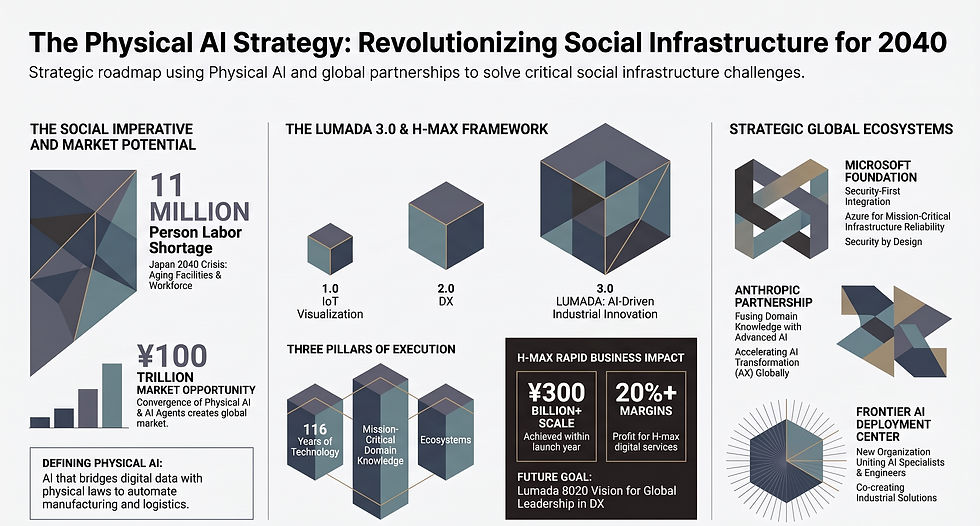
1. The Impending Infrastructure Crisis and the 100-Trillion-Yen Solution
Modern society is rapidly approaching a critical bottleneck in infrastructure maintenance. Having spent his career building and operating highly reliable, fault-tolerant mission-critical systems for government and municipal clients, Mr. Hosoya delivered a stark warning regarding two upcoming milestones:
The 2040 Problem (Severe Aging & Worker Shortages): By 2040, just 15 years from now, the majority of Japan’s social infrastructure will experience severe aging. Concurrently, the labor force tasked with maintaining this social infrastructure is projected to face a massive deficit of 11 million workers.
The 2050 Problem (Demographic Shift): By 2050, the working-age population is projected to shrink by 30% compared to the 2020s, while senior citizens will make up 40% of the total population.
To rescue social infrastructure from these physical limits, Hitachi is looking beyond basic digital automation. While digital-first AI Agents have quickly evolved to handle cognitive tasks like software development and digital marketing, Hitachi sees an even larger opportunity in Physical AI—AI that operates under the physical laws of the real world, such as robot manipulation in manufacturing or automated sorting in logistics warehouses. By overlapping AI Agents with Physical AI, Hitachi conservatively estimates a market potential exceeding 100 trillion yen.
2. Hitachi's Three Core Strengths for Social Implementation
Applying AI to real-world infrastructure requires an entirely different level of precision and safety compared to deploying it in purely digital spaces. Hitachi is leveraging its unique history to spearhead this transition, relying on three core pillars:
Products & Technology: Backed by 116 years of experience supporting social infrastructure, Hitachi integrates high-quality physical products with advanced control technologies that prioritize safety above all else.
Domain Knowledge: Hitachi possesses deep operational expertise in mission-critical systems where downtime is not permitted. This domain knowledge ensures AI operates correctly within the unique context of each physical site, maximizing reliability.
The AI Ecosystem & "Customer Zero" Approach: Hitachi leverages its strict internal quality standards by treating its own vast group of companies as its first customer. Through this "Customer Zero" initiative, technologies are aggressively tested and verified internally before being scaled to the market, with any technological gaps bridged by global partner ecosystems.
3. Evolving Lumada 3.0 and the Commercial Success of "HMAX"
Hitachi’s physical AI strategy is built upon a decade-long foundation of data visualization through its Lumada platform. Lumada has evolved from IoT-driven data collection (Lumada 1.0) to digital transformation (Lumada 2.0), and now to Lumada 3.0, which natively integrates advanced AI.
By extracting operating data from digitized assets and analyzing it with AI refined by Hitachi’s domain knowledge, Lumada 3.0 delivers Hitachi’s proprietary digital service suite: HMAX.
HMAX is currently accelerating digital innovation across three major global markets:
HMAX Energy (Grid & Service Market): Helps utility companies stabilize power grids; currently being adopted by multiple corporations.
HMAX Mobility (Railway Market): Optimizes railway operation technologies globally, notably supporting fleets that include non-Hitachi rolling stock.
HMAX Industry (Frontline Worker Market): Currently undergoing technical validation to automate and evolve skilled labor techniques, ensuring continuous productivity gains.
HMAX has achieved massive commercial validation. In its launch year alone, HMAX achieved a business scale of 300 billion yen with margins exceeding 20%, serving as the prime growth engine for Hitachi’s long-term "Lumada 8020" vision.
4. Fireside Chat: Reconciling High Reliability and Rigid Security in the Real World
A major highlight of the event was a fireside chat between Mr. Hosoya and Ms. Miki Tsusaka, President of Microsoft Japan. The two companies, which established a comprehensive 360-degree strategic alliance in 2024, discussed how they are jointly transforming critical infrastructure.
The Reality of Frontline AI
Ms. Tsusaka emphasized that while digital office workers have easily adopted generative AI, the frontline workers who support physical industries represent about 50% of the Japanese market. Physical AI is the key to empowering this massive segment of the workforce. With natural language processing, humans can now operate complex robotic systems seamlessly, accelerating "agentification" in the field.
Zero Tolerance for Failure
Unlike purely digital AI, which can occasionally output errors without catastrophic consequences, social infrastructure has zero tolerance for failure. A single minute of factory downtime or a minor railway delay impacts society at large.
To address this, Ms. Tsusaka highlighted Microsoft's commitment to safety:
Human-in-the-Loop: Even in highly autonomous Physical AI systems, human decision-makers must remain at the center to provide final authorization and instructions.
Security as a Prerequisite: Microsoft defends against 100 trillion threat signals every single day. Out of its 220,000 global employees, over 34,000 are dedicated security professionals.
Rigorous Frameworks: Microsoft adheres strictly to Secure by Design, Secure by Default, and Secure Operations, cultivating a strict "security-first" corporate culture where compliance training is mandatory to maintain system access.
Shifting to "Predictive Management"
Through the partnership, Hitachi is deploying its Lumada solutions on Microsoft Azure, benefiting from native security and governance. A primary example is Hitachi Energy’s asset management solution, Elipse. By overlaying Hitachi’s equipment and operational data with corporate financial data, AI can simulate future scenarios, allowing companies to transition from "reactive" repairs to "Predictive Management". This approach dramatically increases data transparency and accelerates executive decision-making.
5. A New Frontier: Strategic Alliance with Anthropic
Expanding its global AI ecosystem, Hitachi announced a strategic partnership with Anthropic to integrate world-class Large Language Model (LLM) technology with Hitachi’s century-long domain knowledge.
This strategic alliance is anchored by four core pillars:
Accelerating customers' AX (AI Transformation).
Driving internal "Customer Zero" initiatives by applying Anthropic's technologies to the daily workflows of Hitachi's 290,000 group employees.
Further elevating and automating HMAX solutions.
Establishing the "Frontier AI Deployment Center".
Inside the Frontier AI Deployment Center
The newly established center is designed to serve customers across 190 countries and support Hitachi's internal workforce in leveraging state-of-the-art AI. It will feature a dedicated co-creation team consisting of Applied AI specialists from Anthropic working alongside Hitachi's experts in IT, OT, products, and security. This joint team will collaborate directly with Hitachi’s FDEs (Forward Deployed Engineers) to rapidly build and deploy real-world use cases directly into the field.
Conclusion: Becoming the World's Best User of Physical AI
Closing his address, Mr. Hosoya reiterated Hitachi’s ultimate goal, first declared in October of last year: "To become the world's best user of Physical AI."
By combining its proprietary industrial expertise with a powerful, expanding ecosystem of world-class partners—including Microsoft, Anthropic, and NVIDIA—Hitachi is uniquely positioned to bridge the gap between digital intelligence and physical execution. Through these strategic alliances, the company is set to deliver the rapid innovation of generative AI alongside the decades of unyielding reliability required to keep global social infrastructure moving forward safely.


