

The Frontline Revolution: How Generative AI is Empowering the Global Workforce
- Miki Sadinov
- Jun 25
- 4 min read
The global economy has a hidden architecture, and it isn't found in the glass towers of Silicon Valley or the trading floors of London. It is built by the "deskless" workforce—the 80% of global workers who staff our factories, airports, retail floors, warehouses, and construction sites. Yet, for decades, a massive digital divide has persisted: while information workers received a steady stream of productivity tools, the frontline was often left with paper manuals and radio checks.
We are now witnessing a fundamental shift. The mission is no longer just about digitizing the office; it is about extending the power of industrial innovation to the 80%. This revolution isn't just for the assembly line worker or the field technician; it’s for the Operations Manager, that critical hybrid persona who bridges the gap between the shop floor and the corporate suite, managing Six Sigma quality and root cause analysis in the heat of a warehouse environment. To empower this workforce is to empower the very heartbeat of global operations.
The Retention Crisis and the Productivity Paradox
The industrial sector is currently grappling with a triad of pressures that threaten to destabilize modern operations. To understand the scale of the challenge, one must look at the "Retention Crisis":
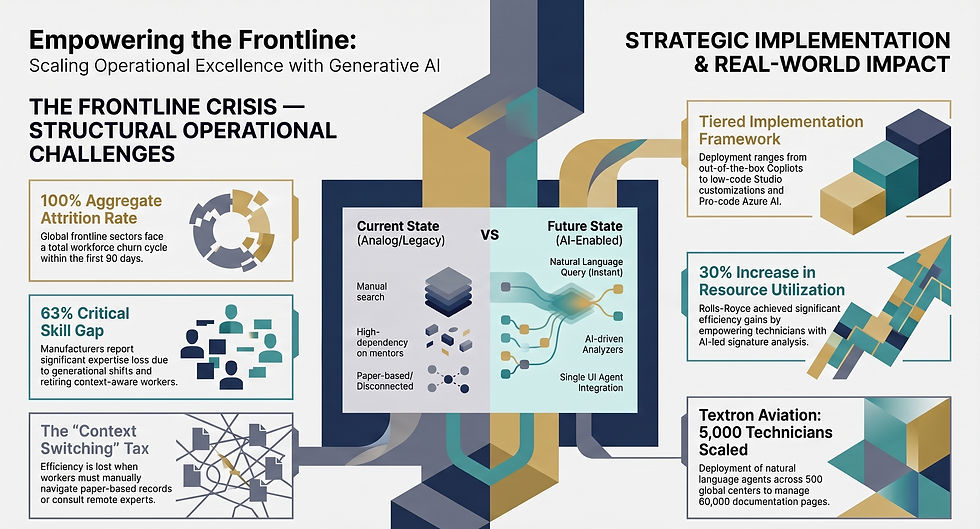
The 90-Day Replacement Cycle: Statistics show a staggering 100% attrition rate for frontline workers globally within their first 90 days. To be clear, this doesn't mean every worker quits simultaneously; it means the churn is so aggressive that many organizations are forced to replace their entire headcount equivalent every three months. This constant cycle of rehiring and retraining is an unsustainable drain on resources.
The Vanishing Skills Base: Approximately 63% of manufacturers report a significant skills gap. As a generation of highly experienced, context-aware veterans retires, they take decades of institutional "tribal knowledge" with them, leaving new hires to struggle without a safety net.
The Context-Switching Tax: Global productivity has stagnated since the early 2000s, largely due to "context switching." Imagine an aviation technician moving from a Boeing engine to a Rolls-Royce engine; they are forced to stop work, hunt for a paper folder "stashed under the seat of a truck," or wait for a senior mentor to become available. This friction is the enemy of efficiency.
Beyond the Productivity Hype: Maturity and the Knowledge Loop
When Generative AI first arrived, the conversation focused narrowly on time-saving. However, industrial leaders soon hit a philosophical wall: "If I turn an eight-hour task into a four-hour task, what do I do with the worker for the other four hours? Do they just take a longer coffee break?"
The answer lies in Operational Maturity. AI is moving beyond simple "shortcuts" to address three strategic pillars:
Engagement: Connecting the worker to the business so they feel their expertise is valued.
Empowerment: Giving workers the autonomy to solve complex on-site problems without a laptop.
Efficiency and the Knowledge Loop: This is the most critical evolution. True maturity means using AI to capture frontline insights and feed them back into the organization’s data ecosystem. It’s about operational planning—ensuring the right worker is at the right task at the right time, rather than just working faster.
The Agent-First Architecture: One Interface to Rule the Floor
The strategy for deploying AI on the frontline must be frictionless. We cannot expect a technician covered in grease to navigate a dozen different apps. The industry is moving toward a "single user interface" strategy, where AI agents act as the universal entry point. Microsoft and its partners are delivering this through three distinct technical pathways:
Out-of-the-Box (Copilot): Surface-level agents integrated directly into Microsoft 365 (Excel, Word, Edge) and Dynamics 365 Field Service. This brings the AI into the existing flow of work.
Low-Code/No-Code (Copilot Studio): This allows Operational Technology (OT) teams to build custom, secure agents via drag-and-drop or natural language. Crucially, this stays under IT governance, preventing "rogue IT" where unvetted tools proliferate across the factory.
Pro-Code/Custom (Azure AI & Databricks): For high-complexity optimizations, such as specialized machine learning models or deep API integrations, Azure AI provides the heavy lifting. This allows for bespoke solutions, such as the sophisticated data processing required for aerospace maintenance.
Industrial Proof of Concept: Real-World Transformation
Amey: Safety at the Click of a Button
Amey is the infrastructure backbone of the UK, touching the lives of 65% of the British population every single day. For their mobile workforce, access to safety data is a matter of life and death.
By deploying an "agent in the pocket," Amey replaced the manual hunt through paper folders in trucks with a mobile-first digital assistant.
The AI can translate complex safety documentation into any language on the fly, ensuring a diverse workforce stays compliant and safe.
Rolls-Royce: Powering the "Flight Hour"
Rolls-Royce doesn't just sell jet engines; they sell "flight hours" via Service Level Agreements (SLAs). If an engine isn't in the air, they aren't making money.
Using the Signature Analyzer—a high-complexity solution built on Databricks on Azure—technicians can inspect engine blades containing 2 million microscopic holes.
This AI-driven inspection has led to a 30% increase in utilization, directly impacting the "Power by the Hour" business model by keeping planes in the sky and ensuring regulatory compliance with pinpoint data.
Textron Aviation: Decades of Knowledge, Instant Answers
Textron (the parent of Cessna and Beechcraft) manages a staggering 60,000 pages of technical documentation across 50 different aircraft models.
They developed TAMI (Team Aviation Maintenance Intelligence assistant) to help 5,000 global technicians navigate 15 years of historical records and manuals.
Using natural language, mechanics can query TAMI to find specific maintenance fixes instantly, drastically reducing aircraft downtime and keeping the general aviation fleet moving.
The Industry Roadmap
Generative AI is no longer a "future" technology for the industrial sector; it is a current necessity for solving the systemic issues of attrition and the productivity paradox. By providing a single point of truth through intuitive agent interfaces, organizations can finally bridge the skills gap and treat their frontline workers as the high-value assets they have always been.
For organizations ready to move beyond the pilot phase, resources like Microsoft 365 for frontline workers and Copilot for manufacturing scenarios provide the blueprint. The goal is clear: a safer, more efficient, and more engaged workforce where the collective knowledge of the organization is available to every worker, right in their pocket.


