

The Leapfrog Giants: Decoding India and Africa’s Digital-Economy Transformation
- Miki Sadinov
- Jul 13
- 4 min read
Updated: Jul 14

The "leapfrog" growth model has matured into a definitive economic mechanism, allowing emerging markets to bypass legacy Western structures in favor of decentralized energy, digital consumption, and social-trust finance. As traditional global systems face stagnation, India and Africa have emerged as the primary frontiers for this structural reconfiguration. By integrating real-time digital rails with a massive, youth-led demographic shift, these regions are no longer merely chasing global standards but are functioning as the world’s most active laboratories for the next generation of digital infrastructure.
India's Digital Engine and the Gen-Z Consumption Wave
India’s economic landscape has undergone a strategic pivot, transitioning from the "innovation-first" chaos of the early 2010s to a sophisticated "regulation-first" market (2022–2026). This shift is not a restriction of growth but a foundational de-risking of the market, stabilizing underwriting value chains and providing the transparency required for institutional capital to scale at unprecedented velocity.
The following metrics underscore the magnitude of this transformation:
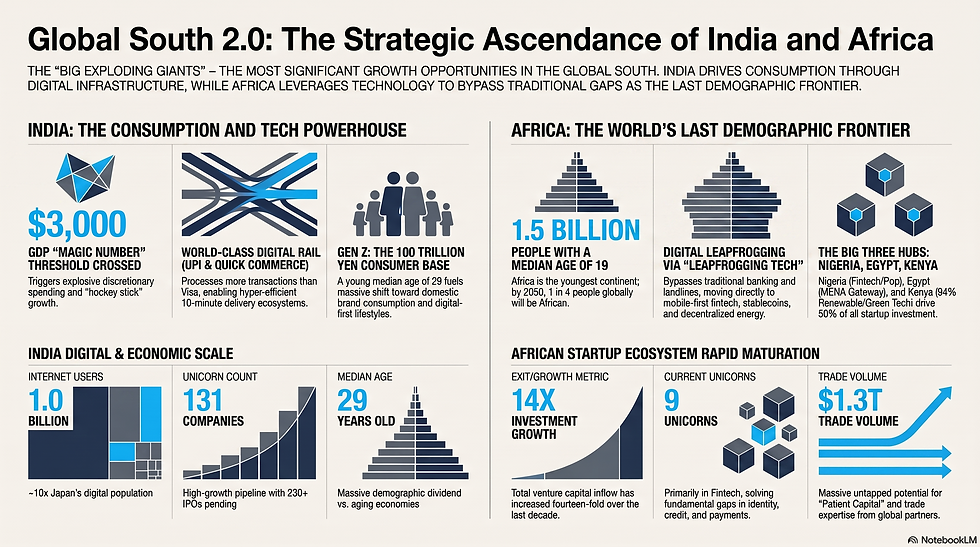
Demographic Dividend: India maintains a population of 1.46 billion with a median age of 29, representing the world's most concentrated labor and consumer base.
Ecosystem Maturity: The nation now boasts 131 Unicorns, a testament to the depth of its venture ecosystem.
Consumption Power: India’s Gen-Z cohort influences $860 billion (¥100 trillion) in annual spending, dictating market trends through digital-first discovery.
The $3,000 Threshold: Per capita GDP is crossing the $3,000 "magic number," signaling the start of the "hockey-stick" phase where discretionary spending on non-essential services accelerates exponentially.
Digital Rails: The convergence of Aadhaar, Jan Dhan, and UPI has been catalyzed by Jio, which achieved a 95% reduction in data costs, effectively democratizing internet access for over a billion people.
Real-Time Payments: India’s payment infrastructure leads the world, processing over 20 billion monthly UPI transactions—a volume that now dwarfs traditional global credit card networks.
A centerpiece of this evolution is the Quick-Commerce Revolution. Leaders like Blinkit, Swiggy Instamart, and Zepto have redefined urban logistics, moving beyond convenience to make 10-minute delivery a vital utility for groceries and household essentials. Furthermore, India is strategically skipping the "Infrastructure/LLM" race to dominate the "AI Application and Data Creation" race. This is evidenced by the democratization of high-end services: platforms like Supernova (English learning) and Superliving (wellness) have seen 10x valuation jumps by making specialized coaching affordable to the masses.
This technical surge is fueled by a radical shift in ambition; the elite graduates of IIT and BITS—whose technical superiority has been noted by Japanese firms hosting interns in Tokyo—now eschew roles at Google or Facebook to target $5 million seed rounds for their own ventures. Investors should look toward the Global Fintech Festival this September as the next major pulse-check for this corridor.
Africa’s Mobile Infrastructure and Green Transitions
Africa represents the world’s youngest continent, with a median age of 19 and a current population of 1.5 billion, projected to reach 2.5 billion by 2050. This demographic pressure is forcing a rapid leapfrog in infrastructure, particularly in mobile connectivity and renewable energy.
The hardware foundation of this expansion is dominated by Transsion (TECNO, Infinix, itel). Holding a 49% market share, Transsion has provided the affordable smartphone gateway necessary for millions to enter the digital economy.
The "Big Four" markets continue to lead the continent's capital absorption:
Kenya: A global pioneer in green energy, with 94% of its national grid powered by renewable sources (geothermal, wind, and hydro), making it an ideal hub for ClimateTech and EV startups.
Egypt: Serving as a vital gateway between Africa and the Middle East (MENA), it is increasingly attracting massive liquidity from Saudi Arabian and UAE sovereign funds.
Nigeria and South Africa: These remain the primary engines for fintech and industrial innovation.
A pivotal proof point for this ecosystem remains the 2020 acquisition of Paystack by Stripe for $200 million. This exit demonstrated that African startups could achieve world-class technical integration and valuations, fundamentally shifting the global perception of African venture risk.
Decentralized Fintech Pioneers: Converting Challenges into Assets
Startups in these regions are solving systemic gaps by digitizing localized social behaviors and addressing liquidity crises with high-tech solutions.
Rank (formerly Moni): Community-Powered Finance
Rank digitizes the "social capital" inherent in traditional community trust systems, such as the Japanese tanomoshiko (a centuries-old Japanese mutual-aid credit pool where members regularly contribute funds that are sequentially distributed to one member at a time through bidding or lottery) or moai (a traditional community-savings and social network originating in Okinawa where members pool funds monthly and gather to strengthen social ties). By allowing groups to save and borrow collectively, the platform converts social accountability into a formal credit metric, providing a lifeline to those ignored by legacy banks.
Yala: The B2B Trade Desk
Yala addresses the critical US dollar shortage across African markets, a bottleneck for a continent with $1.3 trillion in annual trade volume. By serving as a B2B trade desk that leverages USD-pegged stablecoins (USDC/USDT), Yala allows businesses to settle international trades instantly, bypassing local currency volatility and the lack of traditional FX liquidity.
Regxta: AI-Powered Agency Banking
Regxta targets "high risk" unbanked individuals and refugees through an AI-powered agency banking model. By utilizing local agents and alternative data sets to build credit profiles, Regxta successfully extends microloans to the approximately 100 million people currently in economic quarantine, turning a lack of formal documentation into a managed data asset.
Conclusion: The Horizon of Patient Capital
The digital transformation of India and Africa represents a foundational upliftment of the global consumer base. These regions are no longer "emerging" in the traditional sense; they are the active laboratories for decentralized, resilient infrastructure that the West may one day seek to emulate.
For global investors, the directive is clear: the opportunity lies in providing patient capital to back localized, adaptive platforms. Understanding that these "leapfrog" giants require unique, decentralized solutions rather than imported templates is the key to capturing the value of the next billion digital consumers.


