

The Physical AI Revolution: How NVIDIA, Ricoh, Hitachi, and Waseda University Are Shaping the Future of Autonomous Robotics
- Miki Sadinov
- Jul 9
- 6 min read
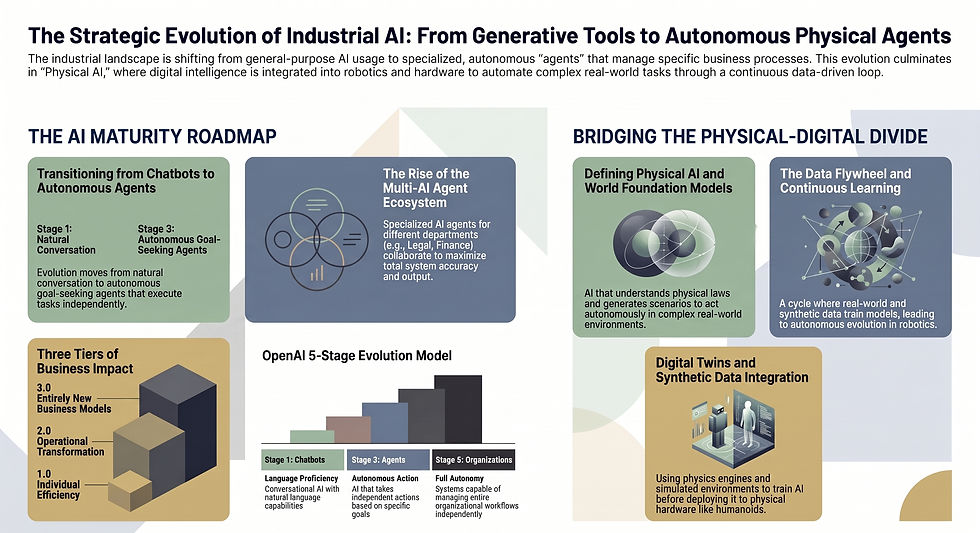
Artificial Intelligence is undergoing a rapid paradigm shift. It is transitioning from screen-bound assistants (Perception and Generative AI) to autonomous software entities (Agentic AI), and finally to Physical AI—intelligence that possesses a physical body (embodiment) to perceive, understand, and act within the real physical world.
This article explores the cutting-edge trends in Multi-AI Agent systems, the rise of Physical AI, and how industry leaders like NVIDIA, Ricoh, Hitachi, and Waseda University are translating these breakthroughs onto real-world factory floors and business operations.
1. The Ascent of Generative AI: From Chatbots to Multi-AI Agent Networks
Enterprise adoption of generative AI has progressed through distinct evolutionary phases, which can be categorized into three primary corporate models:
Generative AI 1.0 (Individual Efficiency): Employing public, off-the-shelf models (such as ChatGPT or Gemini) to complete routine, individual tasks.
Generative AI 2.0 (Operational Transformation): Merging internal enterprise data and localized knowledge with LLMs using Retrieval-Augmented Generation (RAG) to upgrade specific business workflows.
Generative AI 3.0 (Business Model Innovation): Architecting entirely new enterprise solutions, platforms, and business models built on generative intelligence.
Currently, leading corporations are advancing into the Agentic AI era. According to OpenAI’s "Five-Stage AI Evolution Model" (formally compiled and highlighted in executive roadmaps), AI is entering Stage 3 (Agents)—moving past simple Chatbots (Stage 1) and Reasoners (Stage 2) toward autonomous entities capable of taking independent actions based on high-level directives. Unlike basic chat systems, an AI Agent is defined by its ability to autonomously select and utilize external tools, reason step-by-step, and make self-directed decisions to achieve a specified goal.
The latest industry standard is the deployment of Multi-AI Agent systems. By assigning highly specialized data and distinct RAG focus areas to individual agents (e.g., accounting, legal, or product design), companies maximize response accuracy within specific domains. These specialized agents are then linked together to optimize complex, multi-stage enterprise workflows.
In an analysis of advanced digital industrial strategies, several global pioneers have been highlighted for their exploration of Multi-AI Agent architectures:
Toyota Motor Corporation: Leading this wave, Toyota has developed its proprietary "O-Beya (Room) System" to orchestrate specialized AI agents, optimizing overall accuracy and enterprise collaboration.
Other Pioneers: Large-scale enterprises including Honda, BMW, Fujitsu, NTT DATA, and Hakuhodo Technologies are actively highlighted as key case studies in building customized Multi-AI Agent architectures to streamline their respective industrial domains.
2. The Dawn of Physical AI: A 50-Trillion-Yen Paradigm Shift
When AI intelligence gains embodiment and interacts with physical laws, it becomes Physical AI. This transition is estimated by NVIDIA to transform a 50 trillion yen industry (approximately $310–$330 billion USD), spanning factory floors, warehouse logistics, future humanoid robots, and autonomous driving.
NVIDIA is the primary driver of this hardware-and-software convergence. Under accelerated computing (integrating GPUs, CPUs, and high-speed networking), NVIDIA provides the critical infrastructure for Physical AI.
Cosmos Platform and World Foundation Models: NVIDIA’s Cosmos platform is designed to build "World Foundation Models" that allow AI to simulate, predict, and understand the physical consequences of actions.
A Commitment to Open-Source Safety: To prevent vendor lock-in—where past development investments are rendered obsolete by closed, proprietary models—NVIDIA actively commits its major Physical AI models to open-source platforms like Hugging Face and GitHub.
CES 2026 Model Releases: At CES 2026, NVIDIA announced several major open-source model releases:
NVIDIA Alpamayo: A newly released open model for the autonomous vehicle sector.
NVIDIA Cosmos Reason 2 and NVIDIA Isaac GR00T N1.6: Newly released open models for the humanoid robotics field.
Synthetic Data and the PhysX Engine: Collecting physical training data in the real world is incredibly slow and risky. NVIDIA overcomes this bottleneck by bringing CAD files into simulated digital twins. Utilizing its advanced PhysX physics engine, NVIDIA can simulate highly complex physical properties—such as the exact deformation of cloth, the chaotic bouncing of gravel and soil, or structural load weights. Generating infinite volumes of high-fidelity "synthetic data" allows robots to train safely and rapidly via reinforcement and imitation learning before entering the real world.
3. Practical Enterprise Deployment: Ricoh’s "10,000-Agent Army" and Humanoid Robotics
Ricoh stands out as a global leader in translating AI agents from office desks directly to physical production lines.
Scaling the Office: 10,000+ AI Agents
Using the agent-builder tool Dify, Ricoh pioneered a "citizen development" culture where employees across sales, software engineering, and technical departments digitize their tacit knowledge (experience and intuition) into customized AI agents.
Within just one year, Ricoh deployed over 10,000 active AI agents across its organization.
To prevent the common pitfall of low-code tools—where automated workflows break when system environments shift and are abandoned—Ricoh transitioned to Autonomous Agents (Buddies). These self-improving buddies adaptively combine their own skills and hold conversational sessions to extract hidden tacit knowledge from employees.
Ricoh conducts automated "metabolism" cycles to clear inactive workflows (for example, discarding unused agents during the Golden Week holidays, which cleared out approximately 1,000 agents).
Bringing Intelligence to the Factory Floor
Ricoh is actively expanding this office intelligence into the physical manufacturing zone (Physical AI).
World Models via RICOH THETA: Using its signature 360-degree RICOH THETA cameras, Ricoh captures high-fidelity spatial data to construct virtual world models, mapping real-world factory floors directly into digital simulation spaces.
Humanoid Imitation Learning: In these virtual environments, humanoid robots undergo imitation learning to master complex, multi-skilled tasks (such as electronic component assembly, part picking, and product transportation).
The Live Robotics Demo: Demonstrating their progress, Ricoh showcased a humanoid robot performing real-time walking, reversing, single-leg balancing, obstacle negotiation, picking up objects, and executing a delicate hand-to-hand transfer to a human—retaining full physical stability even on half-battery.
Target Deployment: Ricoh actively aims to deploy these humanoid "buddies" across its active factories within approximately two years.
4. Deep Predictive Learning: Waseda University and Hitachi’s Science Robotics Milestone
For robots to succeed in everyday environments, they must navigate unpredictable, real-time "disturbances" (e.g., humans getting in the way or physical obstacles changing positions). To tackle this, Prof. Tetsuya Ogata of Waseda University and Hitachi have engaged in joint research since 2014, pioneering a breakthrough methodology known as Deep Predictive Learning (End-to-End Whole-Body Control).
[Real-Time Sensors] ──────────────────────────► [Single Neural Network] ──────────────────────────► [Direct Joint Motor Outputs]
  (Visuals, forces, tactile inputs)              (Deep Predictive Learning)                        (End-to-End whole-body control)
The Power of End-to-End Control: Conventional robots process actions in segregated steps: "Image Recognition" $\rightarrow$ "Path Planning" $\rightarrow$ "Joint Control". If an unexpected disturbance occurs mid-step, the robot freezes. Waseda and Hitachi’s End-to-End control connects sensory inputs directly to motor outputs via a single, continuous neural network.
Incredible Physical Robustness: When a human physically pushes, pulls, or blocks the joint-controlled robot, the system does not fail. Lacking rigid pre-programmed paths, the robot adaptively self-corrects using learned physical relationships to resume and complete its task.
The Science Robotics Cover Story: This technology was demonstrated in an autonomous laundry-handling robot that successfully performed 4,300 continuous laundry retrieval and folding trials. This landmark research was selected as the cover story for Science Robotics—a highly prestigious, globally recognized feat accomplished entirely by a Japanese research team.
Continuous Temporal Prediction: Language AI models operate in discrete "input-output" queries. In contrast, Physical AI must make continuous, spatial-temporal predictions of its environment. Hitachi’s "IWIM" World Foundation Model utilizes this predictive learning to constantly bridge the gap of physical uncertainty.
5. The Strategic Roadmap: 3 Essential Layers & 4-Step Deployment
To successfully implement AI robotics on a commercial scale, the Head of the Robotics Business at NVIDIA Japan, Mr. Hirano, outlines Three Critical Layers:
The Data Flywheel: Establishing a continuous loop where real-world operational data and high-fidelity simulated "synthetic data" continuously retrain and evolve the robot's world model.
The Integration Layer (OT Convergence): To enable continuous learning, AI must integrate with existing physical machinery, factory systems, and Operational Technology (OT). This deep system integration is a core specialty of industrial leaders like Hitachi.
Reasoning: Empowering the robot with the situational awareness to understand physical phenomena, run logical inferences, and execute goal-oriented actions.
Ricoh’s 4-Step Factory Automation Roadmap
For manufacturers looking to begin their journey, Ricoh advocates a practical, progressive 4-Stage Framework presented officially to its clients, rather than jumping directly to high-cost hardware installation:
  ┌────────────────────────────────────────────────────────┐
  │ Step 4: Full Autonomous Humanoid Deployment            │ -> Deploy specialized AI models directly into humanoids
  └───────────────────────────▲────────────────────────────┘
                              │
  ┌───────────────────────────┴────────────────────────────┐
  │ Step 3: Custom Agent Creation                          │ -> Deploy targeted agents for specialized processes
  └───────────────────────────▲────────────────────────────┘
                              │
  ┌───────────────────────────┴────────────────────────────┐
  │ Step 2: System Data Integration (ERP, PLM, etc.)       │ -> Break data silos across ERP and engineering platforms
  └───────────────────────────▲────────────────────────────┘
                              │
  ┌───────────────────────────┴────────────────────────────┐
  │ Step 1: Document Unification via RAG                   │ -> Make physical blueprints, manuals, & tacit knowledge readable
  └────────────────────────────────────────────────────────┘
6. Conclusion: A Demographic Imperative for Global Industry
For nations facing rapid demographic declines and shrinking workforces, the deployment of Physical AI is not a luxury—it is an absolute necessity.
As Prof. Ogata elegantly points out, we are witnessing a fundamental shift: "Historically, humans had to painstakingly restructure entire factory floors to accommodate the rigid, limited capabilities of robots. With Physical AI, the robot's intelligence is finally flexible enough to adapt to existing, human-centric environments without modifying the physical space."
The next five years will determine which enterprises successfully build their data flywheels, digitize their workforce's tacit knowledge, and claim the competitive high ground in the Physical AI era.


