

Bridging the Gap: How the Asian Development Bank Connects Global Startups to High-Impact Development Opportunities
At the prestigious SusHi Tech Tokyo 2026 global tech summit, in the session titled "Innovation in Action: Connecting Startups to ADB Opportunities," representatives from the Asian Development Bank (ADB) unveiled an ambitious, tripartite framework designed to bridge the gap between private sector innovation and public sector development needs. Leveraging Tokyo’s world-renowned urban systems as metaphors, the speakers demonstrated how ADB serves as an "honest broker" and financial catalyst to scale startup solutions across 69 member countries.
Through structural public-private partnerships, targeted technology pilot programs, and dedicated venture capital, ADB is transforming how development work is executed in the Asia and the Pacific region, proving that innovation only succeeds when it can move, reach people, and break through complexity.
The Metaphor of Tokyo: Systems That 'Just Work'
Opening the session, Satoshi Ishii, Director, Strategy and Partnerships Team, Water and Urban Development Sector Office, Sectors Department 2, Asian Development Bank (ADB), introduced a powerful analogy. In Tokyo, millions of citizens navigate highly complex systems—trains run with absolute precision, convenience stores are perpetually within arm’s reach, and pedestrians navigate Shibuya Crossing without a single collision.
"The remarkable thing is, we don't even have to think about it. It just works," Ishii noted.
However, replicating these seamless systems in emerging economies presents deep structural challenges. Infrastructure is often lacking, markets are volatile, and pathways to scale are highly complex. To address this, ADB—a multilateral development bank representing 69 member countries (including 50 from the Asia and the Pacific region, spanning from the Cook Islands to Georgia)—acts as the system designer. By coordinating governments, public entities, startups, and private financiers, ADB ensures that innovative solutions are not just ideated, but successfully deployed to yield tangible developmental results.
1. Movement: Mobilizing Private Capital and Structuring PPPs
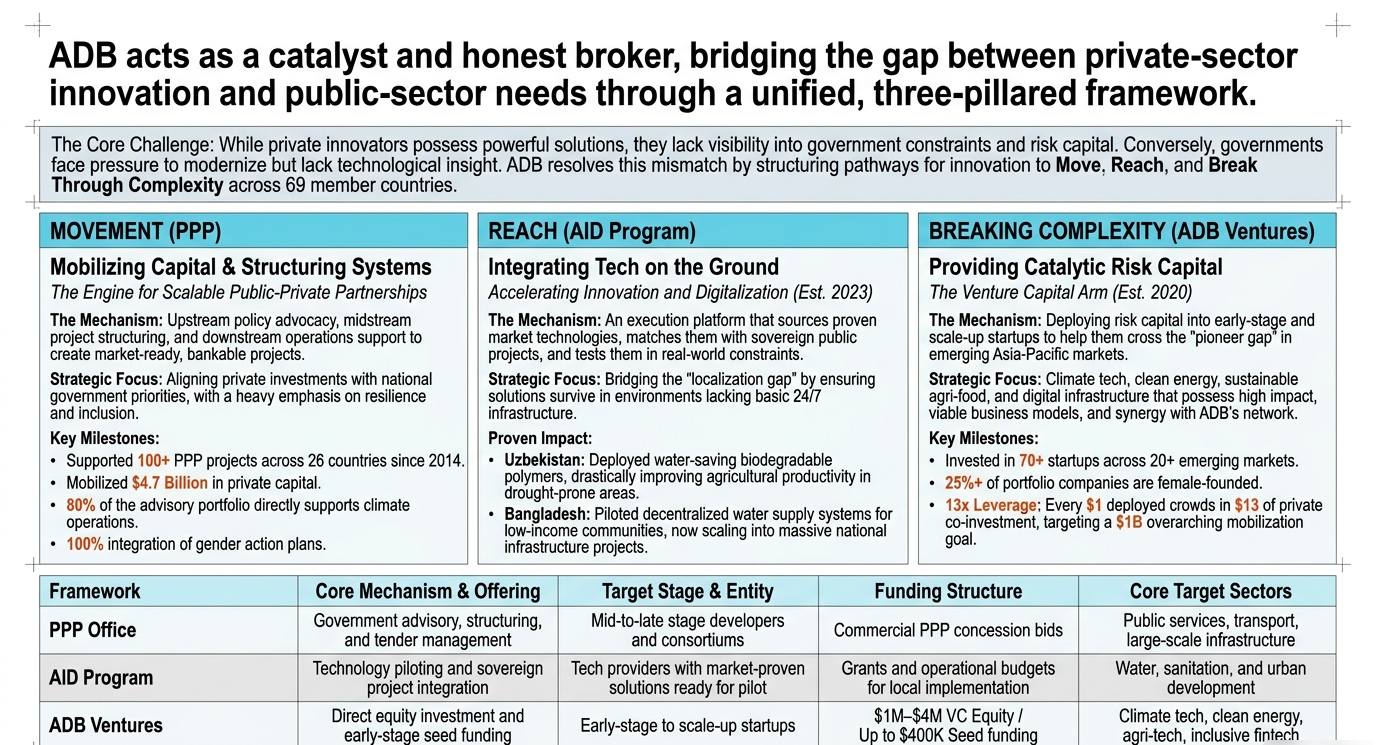
Innovation is meaningless without a vehicle to carry it forward. Ichiro Aoki, Principal Markets Development Advisory Specialist at ADB’s Office of Markets Development and Public-Private Partnership, highlighted that while governments face immense pressure to modernize public services, they frequently lack visibility into the rapidly evolving tech landscape. Conversely, startups possess powerful solutions but struggle to understand public constraints.
"The challenge is not the lack of innovation," Aoki emphasized. "The challenge is connecting private sector innovation with public sector priorities."
To accelerate this "movement" of innovation, ADB provides comprehensive support across the entire Public-Private Partnership (PPP) spectrum:
Upstream (Policy & Advocacy): ADB helps governments build enabling regulatory environments so that innovative business models can take root.
Midstream (Project Structuring & Tendering): ADB assists public counterparts in designing, structuring, and tendering projects, turning raw technological concepts into highly bankable, market-ready investment opportunities.
Downstream (Operations & Maintenance): Beyond financial closure, ADB remains engaged to ensure that technologies are sustained and continue to deliver public benefits over the long term.
The Impact of ADB’s PPP Initiatives
Since 2014, ADB’s advisory arm has successfully supported more than 100 PPP projects across 26 countries, achieving remarkable scale:
$4.7 Billion Mobilized: Facilitated billions of dollars in private capital investments aligned with public development priorities.
Climate-Centric Portfolio: Currently, 80% of ADB’s PPP advisory portfolio directly supports climate-responsive, resilient operations.
Inclusion-Driven: 100% of these projects incorporate tailored gender plans to guarantee equitable development outcomes.
2. Reach: Embedding Technology on the Ground via the AID Program
Even when capital moves, it must effectively reach the communities that need it most. In emerging regions, basic utilities like 24/7 clean water, hygienic toilets, and reliable sanitation remain scarce. Many startups fail in these markets because their technologies are not adequately adapted to the harsh constraints of local environments.
To address this deployment gap, ADB launched the AID (Accelerating Innovation and Digitalization) program in 2023. Operating as an execution platform within the Water and Urban Development Sector, AID integrates commercial, cutting-edge technologies directly into ADB’s massive public sector sovereign projects.
The AID program manages the end-to-end journey of technological scaling:
Sourcing & Matching: Identifying cutting-edge market solutions and aligning them with the specific conceptual needs of municipal and regional projects.
Implementation Support: De-risking and facilitating the physical deployment of tech solutions on the ground.
Validation & Scaling: Providing rigorous, independent validation of technology performance, creating a pathway to scale these innovations across larger ADB-financed public projects.
AID in Action: Real-World Case Studies
Uzbekistan (Agriculture & Water Efficiency): The program piloted water-saving biodegradable polymers, enabling local farmers to drastically improve crop productivity while conserving vital water resources in a drought-prone region.
Bangladesh (Decentralized Utilities): A pilot for a decentralized water supply system was deployed in a low-income community. Following validated success, the model has been integrated into a significantly larger, state-wide urban infrastructure project.
3. Breaking Through Complexity: ADB Ventures and Risk Capital
For early-stage startups, the ultimate barrier to scaling in emerging markets is complexity—ranging from market-specific operational hurdles to the chronic lack of risk capital. Launched in 2020, ADB Ventures, the venture capital arm of the Asian Development Bank, was specifically established to de-risk and "crowd in" private investment for startups addressing climate change, clean energy, digital inclusion, and sustainable food systems.
"The markets where the problems are the most urgent are still the same markets where risk capital is missing," stated Pang Sittakaradej, Head of Seed at ADB Ventures. "We built ADB Ventures to sit in that gap and help these innovations cross it."
ADB Ventures deploys two distinct financial programs tailored to a startup’s developmental lifecycle:
Core Investment Vehicles
Venture Capital Fund (Scale-up Stage): Provides $1 million to $4 million in equity investments for companies ready for commercial expansion. ADB Ventures actively co-invests with leading regional VCs and provides long-term follow-on funding.
Seed Capital Program (Early Stage): Offers up to $400,000 to early-stage startups that have a viable product but need to validate market assumptions, pivot business models, and build operational traction ahead of their next major institutional fundraising round.
Unprecedented Portfolio Success
Scale and Reach: To date, ADB Ventures has backed over 70 startups active across more than 20 emerging markets in Asia and the Pacific.
Gender Equality: Over 25% of portfolio companies are female-founded, reflecting a core commitment to gender equity.
13x Crowding-In Effect: For every $1 deployed by ADB Ventures, the fund has mobilized over $13 in private co-investment, with a long-term goal of driving over $1 billion of private capital into regional climate and impact tech.
What ADB Ventures Looks For
Startups seeking investment from ADB Ventures must align with three fundamental pillars:
Impact Potential: Direct, scalable solutions to urgent climate, environmental, or social problems.
Business Viability: A robust, self-sustaining, and commercially viable business model.
Value-Add Potential: Opportunities where ADB’s vast governmental, corporate, and internal network can uniquely catalyze the startup’s market access.
Program Comparison Matrix: Navigating ADB Opportunities
To assist startups in navigating these entry points, the table below contrasts ADB's main operational frameworks:
Feature | Office of Markets Development (PPP) | AID Program | ADB Ventures |
Primary Mechanism | Government advisory and project tendering | Technology pilot and project integration | Direct equity and seed capital investments |
Focus Stage | Mid-to-late stage developers and consortia | Proven market tech ready for physical pilot | Early-stage and scale-up startups |
Funding Structure | Tendering of commercial PPP concession agreements | Grants / project budgets for local testing | VC Equity ($1M–$4M) & Seed Capital (up to $400k) |
Geographic Scope | ADB Developing Member Countries (26 countries) | Municipal and sovereign urban projects | Over 20 emerging markets in Asia and the Pacific |
Core Sectors | Public services, transport, large-scale infrastructure | Water supply, sanitation, urban development | Climate tech, clean energy, agritech, fintech |
Key Performance Indicator | $4.7 billion private capital mobilized since 2014 | Scaled-up state-wide implementation (e.g., Bangladesh) | 13x capital crowding-in ratio; 70+ startups backed |
A Call to Global and Japanese Innovators
With its physical presence at SusHi Tech Tokyo 2026, the Asian Development Bank issued a direct call to action to global innovators, including those based in Japan. To ADB, a startup's country of origin is secondary to the adaptability and execution potential of its solution.
For startups looking to scale, the message from SusHi Tech Tokyo is clear: by aligning with ADB's structured PPP pipelines, the AID deployment platform, or ADB Ventures' risk capital, the most ambitious technologies can transition from local ideas into scaled, systemic solutions that define the future of sustainable development in Asia and the Pacific.


