

Open Innovation Between Japan and Malaysia: Third Ecosystem and Universiti Malaya Co-Host Startup Pitch Event (September 2026)

更新日:1 分前
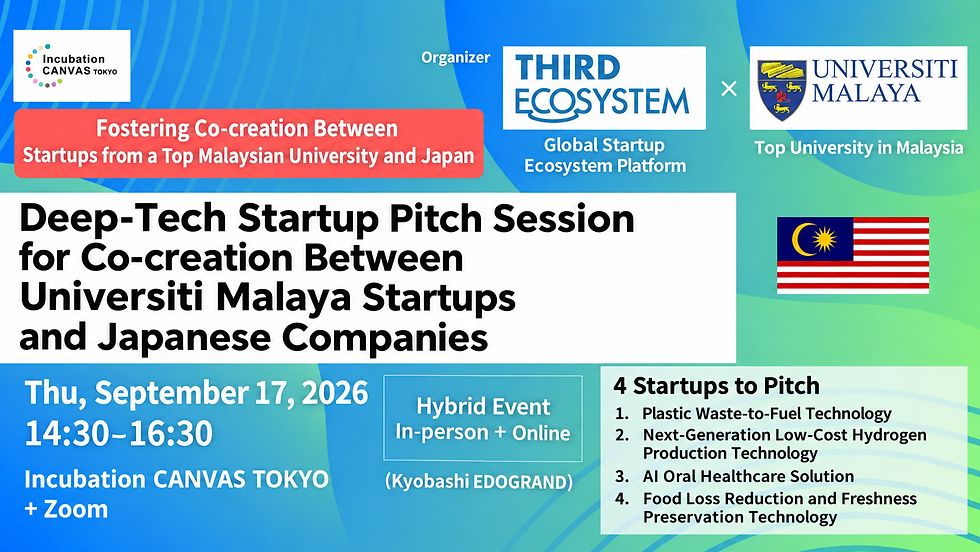
As Asia’s innovation landscape undergoes significant transformation, a new initiative is gaining momentum to connect Southeast Asia’s advanced technologies with Japan’s technology and investment ecosystem. Third Ecosystem, an innovation facilitation platform, and Universiti Malaya, Malaysia’s leading university, recently co-hosted a startup pitch event, with Incubation CANVAS TOKYO, operated by artience Co., Ltd., participating as a sponsor. At the event, deep-tech startups emerging from Universiti Malaya’s research presented their technologies and business opportunities to Japanese industries, investors, and market ecosystem stakeholders. The event attracted more than 50 registrations and brought together a diverse range of participants, including major Japanese corporations, emerging companies, universities, research institutions, and venture capital firms (VCs) exploring collaboration and business co-creation opportunities with overseas startups. This article introduces Universiti Malaya and the deep-tech startups originating from the university, as presented during the event.
Universiti Malaya: Malaysia’s Leading Research Institution and the Innovation Support Capabilities of UMCIE
Dr. Lee from the University Malaya Centre of Innovation and Enterprise (UMCIE), a co-organizer of the event, opened the presentations with a detailed introduction to the university’s historical background and its research and entrepreneurship support ecosystem.
Universiti Malaya traces its origins to a medical school established in 1905 and is Malaysia’s leading institution of higher education, with a history spanning more than 100 years. In 1949, King Edward VII College of Medicine and Raffles College merged to form the University of Malaya, and the Kuala Lumpur campus was established in 1962, shaping the institution as it exists today. The university currently comprises 14 faculties and two academies, covering a wide range of academic disciplines, including engineering, science, medicine, pharmacy, dentistry, and information technology. Its total student population is approximately 38,000, including around 20,000 undergraduates and 18,000 postgraduate students, representing a nearly ideal one-to-one ratio. The university also welcomes more than 9,000 international students from around the world. Ranked 56th globally in the QS World University Rankings, Universiti Malaya has firmly established itself as one of Asia’s leading research universities.
The university houses more than 70 specialized research centers, including numerous high-impact research centers responsible for nationally significant research initiatives. Examples include UMP, which conducts renewable energy research; the Photonics Research Centre, which leads research in optical fiber technologies; the Marine Research Centre; the Tropical Infectious Diseases Research Centre; the Advanced Materials and Nanotechnology Research Centre; and the Medicinal Mushroom Research Centre. Together, these institutions demonstrate the university’s outstanding expertise across a broad spectrum of advanced technological fields.
UMCIE serves as the central organization responsible for translating these advanced research outcomes into societal value and promoting their commercialization. Acting as the university’s technology transfer office (TTO), UMCIE comprehensively manages intellectual property (IP) protection for researchers’ inventions, including patent applications and copyright management, as well as technology licensing and rights transfers to companies, pilot demonstrations, and collaborative research with industry partners. Furthermore, through its Deep Tech Startup Accelerator Programme and Life Sciences Accelerator Programme, UMCIE supports researchers in establishing startups and provides funding for prototype development.
UMCIE’s comprehensive entrepreneurship support system is reinforced by strong partnerships with external ecosystem stakeholders. Approximately 50% of companies participating in its accelerator programs have been selected for the CIP Spark program offered by Cradle Fund, a Malaysian government-backed startup support organization. UMCIE also collaborates with the Malaysian Business Angel Network (MBAN), the Selangor Digital Economy Corporation (SDEC), Hong Kong’s Technopole, and overseas partners in Taiwan and Singapore, actively supporting startups in soft-landing initiatives and international expansion.
In terms of its intellectual property portfolio, engineering accounts for approximately 40%, followed by science-related fields, including biotechnology, geology, and chemistry, at approximately 25%. Medicine, pharmacy, dentistry, and information technology make up the remaining major categories. Particularly in the medical field, University Malaya Hospital, located on the university campus, functions as a testbed for advanced medical technologies, enabling a rapid cycle from basic research to clinical validation. At this pitch event, four promising startups emerging from this robust academic and validation infrastructure presented their innovative technologies and visions for collaboration in Japan, covering renewable energy, healthcare AI, and agricultural biotechnology.
Sustainable Technology (LiquidPro): Converting Hard-to-Recycle Plastics and Agricultural Residues into High-Value Liquid Fuels
The first presenter was Sustainable Technology, a greentech startup developing its technology under the brand name “LiquidPro.” Dr. Muhammad Fazli and his team introduced a groundbreaking thermochemical conversion solution addressing the global challenges of plastic waste and agricultural residue disposal.
Approximately 300 million tons of plastic waste are generated worldwide annually. While clean, single-material plastics can be mechanically recycled, hard-to-recycle plastics—including mixed plastics, contaminated plastics, multilayer films, and low-value plastics—are difficult to collect and recycle economically. As a result, much of this waste ends up in landfills or undergoes low-value treatment.
LiquidPro is a technology that thermochemically converts hard-to-recycle plastic waste and hydrocarbon-rich agricultural residues, which cannot be effectively processed using conventional physical recycling methods, into high-quality liquid hydrocarbon fuels (drop-in fuels) and functional chemicals that can be used directly. By combining proprietary catalysts with controlled heat and pressure, the conversion process operates at temperatures of 350°C to 400°C, which the company describes as a relatively low-temperature, low-energy process comparable in power consumption to a microwave oven. Its greatest advantage lies in its ability to process unsorted mixed waste directly and extract high-quality oil in as little as one hour.
According to analyses conducted by third-party institutions, the liquid fuel produced using LiquidPro has demonstrated excellent quality and engine performance equivalent to or better than conventional gasoline and diesel. Furthermore, compared with conventional fuels, the technology has demonstrated outstanding environmental performance, reducing carbon dioxide (CO2) emissions by approximately 70%, carbon monoxide (CO) emissions by 25%, and unburned hydrocarbons by 55%. In terms of cost, while the global average cost of mechanical recycling is approximately USD 640 per ton, LiquidPro’s conversion cost is approximately USD 400 per ton, providing a significant cost advantage.
The company operates a diversified revenue model consisting of tipping fees collected from municipalities and waste management operators, fuel-return packages that provide feedstock suppliers with either 40% or 80% of the fuel produced, and a direct sales model through which the company sells the resulting fuel to industrial users and petrochemical manufacturers.
Regarding expansion into Japan, the company views Japan, which generates more than 8 million tons of plastic waste annually, not merely as an export destination for its products but as a strategically important market for advanced technology validation and commercialization. By leveraging Japan’s sophisticated waste collection and intermediate treatment infrastructure, as well as its robust regulatory framework under the Act on Promotion of Resource Circulation for Plastics, the company aims to position LiquidPro not as a replacement for existing recycling systems but as a complementary solution that recovers residual waste streams that would otherwise remain unutilized. The company strongly emphasized its interest in co-creation with Japanese partners for pilot demonstrations.
Zaffron: Dramatically Reducing Green Hydrogen Production Costs Through Zero-Gap, Membrane-Free Water Electrolysis Technology
Next, Dr. Shakil of Zaffron presented an innovative approach to dramatically reducing the production cost of green hydrogen through next-generation electrolyzer technology. As industries such as steel, chemicals, fertilizers, and fuels increasingly look to green hydrogen to achieve decarbonization, approximately 95% of the hydrogen currently in circulation is still grey hydrogen derived from fossil fuels. The greatest barriers to widespread green hydrogen adoption are the enormous capital expenditures (CAPEX) and operating expenditures (OPEX) associated with water electrolyzers. Conventional water electrolysis systems, including proton exchange membrane (PEM) electrolyzers, require rare and expensive precious metal catalysts such as platinum and iridium, as well as fragile and costly electrolyte membranes. With CAPEX reaching USD 1,000–2,000 per kilowatt, these technologies have faced challenges in achieving economic viability without large-scale, gigawatt-class facilities.
Zaffron has developed and patented a “zero-gap, membrane-free water electrolyzer” that eliminates the need for expensive membranes and precious metals. By removing the membrane, the company has dramatically simplified the system’s structure while overcoming supply chain disruption risks and durability challenges. This proprietary design achieves energy efficiency of up to 70% and maintains high stack performance comparable to PEM systems while significantly reducing equipment costs. In addition, its modular cascade configuration enables flexible scaling according to demand.
The company has set an ambitious green hydrogen production cost target of USD 2–3 per kilogram, positioning its technology as highly price-competitive. Its business development roadmap begins with hydrogen carbon-cleaning equipment and services for engines, a market segment that allows relatively rapid market entry and has already begun generating revenue. The company subsequently plans to develop large-scale, 1-megawatt-class electrolyzers and license its technology to global markets, including the ASEAN region.
Looking ahead to the Malaysian government’s target of producing 22 million tons of hydrogen annually by 2050, representing an estimated USD 400 billion domestic market opportunity, Zaffron is pursuing strategic partnerships with major energy companies such as Sarawak Energy and Petronas. Following the acquisition of its patent in 2023 and the establishment of the company in 2024, Zaffron completed a Cradle grant program in 2026. The company is currently raising USD 1.5 million in seed funding to further accelerate R&D and validate its technology in real-world environments. It is seeking partnerships with Japanese energy companies and equipment manufacturers for joint development and demonstration projects.
Oral View: A Preventive Dental Care Ecosystem Powered by AI and a Patented Proprietary Device
The third presenter, Dr. Simson of Oral View, introduced an AI-powered home preventive dental care platform developed by a healthcare startup founded by Dr. Tan Ngiap Chuan of Universiti Malaya. Although Japan has an advanced healthcare system, surveys on dental health reveal delays in preventive care and early-stage treatment. According to 2022 survey data, approximately 50% of Japan’s population has periodontal pockets measuring 4 millimeters or deeper, while 33% of elementary school students have dental caries (tooth decay). Furthermore, in Japan’s super-aged society, where 29% of the population is aged 65 or older, the risk of dental disease continues to increase due to age-related declines in immunity and mobility limitations. Consequently, annual dental care expenditures in Japan have reached JPY 3.2 trillion, accounting for approximately 7% of total national healthcare expenditures and representing a substantial economic burden.
To address these challenges, Oral View offers an advanced preventive healthcare solution that allows individuals to easily assess their oral health at home. The process is extremely simple: users take images of their teeth and oral cavity using a dedicated imaging device developed by the company. The captured images are immediately transmitted to a cloud server, where an AI engine (“AI Brain”) automatically analyzes their oral condition and delivers a detailed report to the user’s smartphone application, indicating risk levels for periodontal disease and tooth decay.
For minor issues, the application’s chatbot provides guidance on proper brushing techniques, when to replace toothbrushes and toothpaste, and how to use dental floss effectively. When professional treatment is deemed necessary, the platform includes a connection feature that enables users to find, match with, and book appointments at suitable dental clinics near their homes, providing a comprehensive, one-stop oral care ecosystem.
The technology has currently reached the clinical validation stage, with a Technology Readiness Level (TRL) of 5–6. In December 2025, the company began clinical trials involving members of the general public in collaboration with a team of dental specialists at University Malaya Hospital. As of 2026, approximately 5,000 high-quality oral images annotated by specialists have been collected and accumulated, contributing to significant improvements in the AI system’s diagnostic accuracy. Compared with conventional large-scale dental scanners used in dental clinics, such as iTero, the solution is significantly less expensive and offers a much lower barrier to adoption.
Estimating its global total addressable market (TAM) at USD 4.5 billion as of 2026, the company has secured development grants from Malaysia’s Ministry of Economy and Cradle to further mature its technology. Looking ahead, Oral View is eager to collaborate with Japanese strategic partners and investors to localize its hardware and applications according to Japanese user preferences and the needs of dental healthcare providers, as well as to pursue patent protection in Japan for technology already patented in Malaysia.
Spray Fresh: A Natural Peptide-Based Post-Harvest Freshness Preservation Spray That Eliminates the Need for Refrigeration
The final presentation was delivered by Dr. Nasrul of Spray Fresh and Professor Othman, who has more than 40 years of experience in biotechnology research. They introduced an agricultural biotechnology solution designed to support sustainable agriculture.
Fresh produce, including fruits and vegetables, deteriorates and spoils throughout the entire process from harvesting to distribution, retail, and consumption, causing substantial food losses worldwide. In Malaysia, up to 40% of fresh produce, valued at approximately MYR 720 million annually, is discarded before consumption. Across ASEAN countries, including Indonesia, losses amount to tens of billions of dollars. Japan also generates approximately 4.6 million tons of food loss annually, making improvements in freshness preservation technology an urgent priority for both agricultural imports and exports.
The company’s “Spray Fresh” is an organic peptide-based spray formulation developed through advanced biotechnology research. It dramatically extends the shelf life of fresh produce through natural means, without relying on cold-chain logistics or conventional chemical preservatives. The product’s primary active ingredients are antimicrobial peptides, which are short chains of amino acids that selectively disrupt the cell walls of microorganisms responsible for spoilage on agricultural products. As the formulation consists entirely of natural ingredients, it is non-toxic, environmentally friendly, and does not carry any risk of inducing antibiotic resistance. It enables fresh produce to retain its appearance, shape, and original quality while preserving freshness safely.
In terms of demonstrated performance, applying Spray Fresh can extend the average shelf life of a wide range of fresh agricultural products by approximately twofold. Specifically, the freshness preservation period increases from 5 to 10 days for fruits, from 6 to 11 days for vegetables, and from 4 to 8 days for organic products. Its effectiveness has been demonstrated across a broad range of crops, including bananas, pineapples, mangoes, cabbages, jackfruit, and even durians intended for export. These research findings have also been published in internationally recognized Tier 1 academic journals, providing a high level of confidence in the supporting data.
By reducing excessive dependence on cold-chain logistics, which are costly and considerably more complex to manage, the technology can reduce logistics costs for businesses by up to 60% and transportation-related carbon dioxide emissions by up to 50%. The technology has currently reached the pre-commercialization stage, with a Technology Readiness Level (TRL) of 8–9. Discussions are underway regarding commercial contracts with large-scale banana plantations and leafy vegetable producers in Malaysia, while international expansion is accelerating through initiatives in Indonesia, Morocco, and field demonstrations involving strawberries in Brazil.
For the Japanese market, the technology offers significant value as a pesticide-free solution for maintaining high-quality product branding, both in the context of Japan’s efforts to expand agricultural, forestry, fishery, and food exports to JPY 5 trillion by 2030 and in improving the quality of agricultural products imported from ASEAN countries. The company is seeking partnerships with organizations possessing expertise in regulatory approval procedures in Japan, as well as demonstration and investment partners capable of developing distribution networks.
Conclusion
The joint pitch event organized by Third Ecosystem and Universiti Malaya, with the sponsorship of Incubation CANVAS TOKYO, was a great success. More than simply a showcase for startups, the event provided a valuable opportunity for the innovation ecosystems of Japan and Malaysia to connect and engage in meaningful exchange.
Third Ecosystem will continue to create open innovation opportunities between global startups and Japanese companies, contributing to the resolution of sustainable societal challenges and the creation of new market value.


