

Beyond Surveillance: How Seoul, Barcelona, and Tokyo are Pioneering Citizen-Centric Smart Cities (SusHi Tech Tokyo 2026)
更新日:8月26日
Session Name
Smart Cities Evolving for Citizens: Creating the Future Together with Leading Cities
Speakers
Moderator: Yuji Yoshimura (Project Associate Professor, Research Center for Advanced Science and Technology [RCAST], The University of Tokyo)
Panelists:
Atsushi Deguchi (Executive Director and Vice President, Professor at the Graduate School of Frontier Sciences, The University of Tokyo)
Maria Buhigas San José (Chief Architect, Barcelona City Council)
Kang Ock Hyun (Director General, Digital City Bureau, Seoul Metropolitan Government)
Introduction: Defining the "Smart" in Smart Cities
What makes a city truly "smart"? As urban centers globally race to integrate artificial intelligence (AI), big data, and autonomous networks, this fundamental question remains open. At the SusHi Tech Tokyo 2026 panel session, titled "Smart Cities Evolving for Citizens: Creating the Future Together with Leading Cities," global urban pioneers challenged the conventional, technology-first definition of smart cities.
The session, moderated by Yuji Yoshimura, Project Associate Professor at the Research Center for Advanced Science and Technology (RCAST), The University of Tokyo, framed the debate around two contrasting urban archetypes:
The Bottom-Up Smart City: Exemplified by historical 1908 footage of a tram moving through Passeig de Gràcia and La Rambla in Barcelona. Despite having no traffic lights, lane markings, or top-down regulations, pedestrians and transit vehicles self-organized successfully to prevent collisions. Yoshimura defined this organic, human-driven synchronization as a primary pillar of a smart city.
The Top-Down Smart City: Exemplified by the MIT Senseable City Lab’s futuristic model of a traffic-light-free intersection, where autonomous vehicles rely on real-time, algorithmic vehicle-to-vehicle communication to navigate.
Rather than positioning these two models as mutually exclusive, the panel consensus leaned heavily toward a human-centered smart city model. Under this framework, technology serves not to control citizens from above, but to empower them from below, directly elevating their daily quality of life.
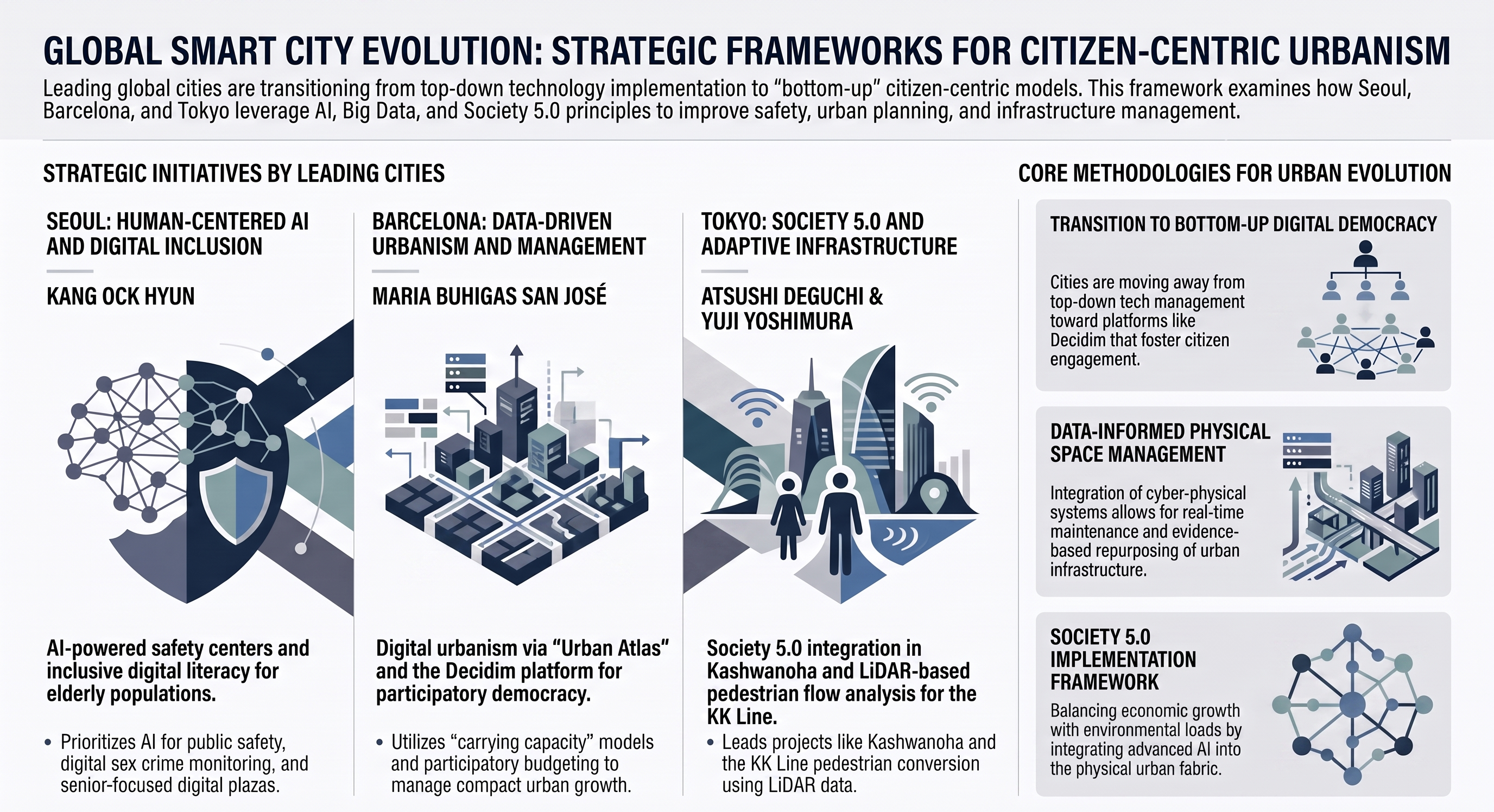
1. Seoul: Safeguarding Lives with "Warm AI" and Digital Inclusion
Representing the South Korean capital, Kang Ock Hyun, General Director of the Digital City Bureau at the Seoul Metropolitan Government, presented the city's official vision to become a "Human-Centered AI City." Guided by the administrative philosophy "It is okay to take your time," Seoul’s technological strategies focus on protecting vulnerable populations and ensuring no citizen is digitally marginalized.
Key structural initiatives in Seoul include:
Integrated Smart Safety Center:
Scale and Connectivity: Seoul manages a massive network of approximately 210,000 CCTV cameras under a single, unified system.
Emergency Integration: The center maintains immediate, real-time links with national police and fire departments.
AI Preemption: Advanced AI algorithms analyze live camera feeds to detect structural risks—such as building fires, pedestrian falls, or criminal activities—allowing emergency services to execute proactive, rapid responses.
AI-Powered Digital Sex Crime Prevention:
Automated Monitoring: Utilizing a customized AI monitoring system, Seoul automatically scans digital networks 24/7 to identify, track, and swiftly remove illegal and non-consensual content.
Holistic Support: Digital intervention is backed by immediate physical-world care, including clinical counseling, legal representation, and specialized psychological support.
Global Recognition: Owing to its drastic reduction in content detection times and soaring removal rates, this program was awarded the prestigious 2024 UN Public Service Award.
Active Digital Inclusion:
Inclusive Digital Plazas: Seoul operates physical community spaces equipped with on-site digital guides who provide personalized, face-to-face tutoring.
Elderly-First Initiatives: This training focuses on helping senior citizens comfortably navigate essential digital interfaces, such as food-ordering kiosks, transit booking systems, and online administrative portals.
2. Barcelona: Democratic Data, Carrying Capacity, and Digital Commoning
Maria Buhigas San José, Chief Architect of the Barcelona City Council, presented a robust methodology demonstrating how open data can restructure urban planning, municipal administration, and civic democracy. In Barcelona, data is deployed as a public utility to understand present realities, optimize daily operations, and model future urban growth.
Barcelona's data-driven urbanism is highlighted by four primary systems:
Zoning Transparency & The Urban Atlas:
Plot-Level Insights: The city’s interactive planning portal translates complex municipal codes into accessible zoning information. Residents looking to buy or rent properties can instantly view historical data and regulatory parameters for any specific plot.
The Compliance Gap: By comparing existing structures with theoretical modern regulations, planners can identify which built spaces date from previous eras and calibrate future regulatory updates accordingly.
Carrying Capacity Modeling: Through a digital Urban Atlas, Barcelona tracks its structural "carrying capacity." Because the city is highly compact and physically bound, expansion is impossible. Instead, the city targets "intensification"—using data models to balance population growth with public facility limits, transit networks, and green spaces.
Physical Public Model: To ground these digital maps in public space, the city has constructed an 83-square-meter physical model of Barcelona, serving as an interactive, physical tool for open discussions with citizens.
Real-Time City Maintenance App:
Data in the Pocket: Since 2017, municipal field workers have used a customized mobile app to log and track maintenance issues across public spaces, lighting grids, roads, and fencing.
Targeted Budgets: This mobile data stream directs an annual maintenance and renovation budget exceeding 400 million euros, shifting operations from reactive repairs to predictive maintenance.
The Barcelona Easy Plan:
Bureaucracy Elimination: Barcelona uses AI to audit municipal archives, identifying and deleting duplicate, conflicting, or obsolete business regulations.
Administrative Consolidation: Rather than forcing citizens to resubmit files repeatedly for public services (such as summer camp subsidies), different administrative branches now share a single, unified database.
Digital Democracy Platforms:
Decidim ("We Decide"): A legendary open-source civic participation platform. A dedicated portion of Barcelona's municipal investment budget is allocated directly according to citizen-led proposals and voting outcomes on Decidim.
Barcelona a la Butxaca ("Barcelona in your Pocket"): A centralized, user-friendly mobile application that integrates all citizen services, tax payments, complaint submissions, and direct semi-annual consultations with the city's Mayor.
3. Tokyo: Society 5.0 and the Pedestrianization of the KK Line
Representing the host nation, Atsushi Deguchi, Executive Director and Vice President of the University of Tokyo, outlined Japan’s national "Society 5.0" framework. Proposed by the Japanese Cabinet in 2016, Society 5.0 envisions a super-smart society where economic advancement and social challenge resolution are achieved by perfectly integrating physical space with cyberspace (cyber-physical systems).
Tokyo's execution of this paradigm spans two groundbreaking scales:
Kashiwanoha Smart City (Chiba Prefecture):
Collaborative Governance: A premier national smart city model developed through joint efforts by the Kashiwa municipal government, Mitsui Fudosan, the University of Tokyo, Chiba University, and local civic organizations.
Four Pillars of Transit-Oriented Development:
Mobility: Operating fully automated, autonomous public bus systems.
Energy: Pioneering a smart grid district energy management system (AEMS).
Public Space: Utilizing AI-guided camera systems to optimize safety and structural flows around transit hubs.
Wellness: Designing proactive healthcare and active-aging programs to address Japan's super-aging demographic.
The KK Line Pedestrianization (Ginza, Tokyo):
The Highway Reclaimed: The KK Line—a 2-kilometer-long elevated expressway running across 14 blocks in central Ginza—began operations in 1966. Its maintenance has historically been funded by commercial spaces leased below the roadway.
The Green Infrastructure Pivot: Decommissioned in April 2025, the KK Line is currently undergoing redevelopment to transform its entire elevated deck into a continuous, public pedestrian forest (resembling New York's High Line) by the 2030s–2040s.
Micro-Scale LiDAR Analysis: During active public social experiments, Deguchi’s laboratory deployed advanced LiDAR (Light Detection and Ranging) scanners to capture and visualize microscopic pedestrian movement. This human flow data will directly dictate the architectural design and spatial layouts of the permanent park.
The Carbon-Neutral Shift: Deguchi presented a structural matrix detailing how future smart cities must use cyber-physical data and behavioral design to decouple economic progress from environmental load, steering urban development toward a net-zero footprint.
Conclusion: A Collaborative Global Urban Future
In his closing remarks, Moderator Yuji Yoshimura reminded the audience of a fundamental academic maxim: "A good question is always better than a good answer." Rather than prescribing a rigid blueprint, the session concluded with four questions directed at urban planners and residents worldwide:
What is the ideal smart city you imagine for your own future?
What kind of urban environment do you actually want to live in?
What are the unique, defining characteristics of Tokyo's smart city model?
How can cities globally build a collective, open-source framework to learn from one another?
The consensus of SusHi Tech Tokyo 2026 was clear: whether through Seoul’s warm safety nets, Barcelona’s open databases, or Tokyo’s pedestrian-first expressways, the future of the smart city belongs to its citizens.


